Braiding Needles
We have 100s of these in our collection…
Director Emily Hicks thinks about the stories they might reveal.
We have 100s of these in our collection…
Director Emily Hicks thinks about the stories they might reveal.
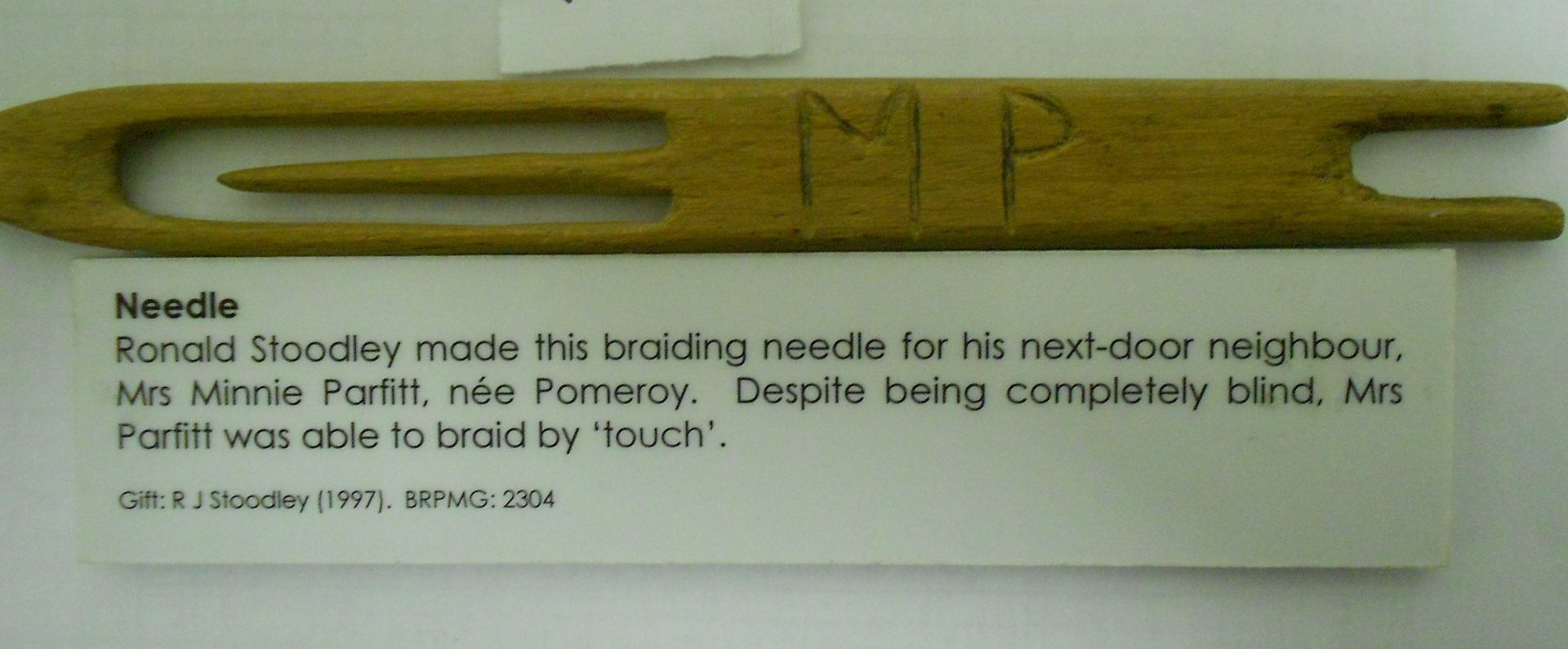
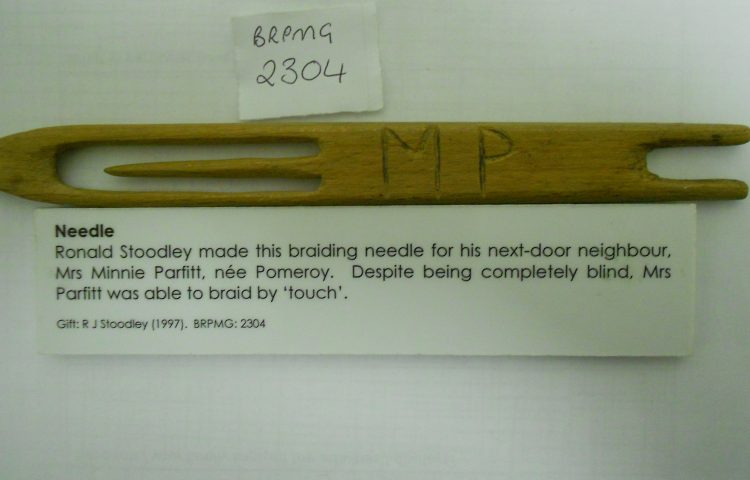
‘Ronald Stoodley made this braiding needle for his next-door neighbour Mrs. Minnie Parfitt, nee Pomeroy. Despite being completely blind, Mrs. Parfitt was able to braid by ‘touch.’
This was an old exhibition label presented with object number BRPMG 2304 in our collection. A net braiding needle with the initials ‘MP’ inscribed in it, a simple object whittled from wood, but one which has so many stories to tell. They are very tactile things: many of the wooden ones have smooth shiny edges, that speak to us of their constant and repetitive use.
These shuttle-shaped wooden or plastic needles were, and still are, used to make net. They come in a range of sizes for different gauges of mesh. The largest in our collection is about 40cm long, and the smallest are around 8cm long. Generally the needles were used by women, often by outworkers who worked at home in the town’s netting industry. Out of all the things in the Museum collection, these are probably the most duplicated. There are around 300 of them, of which about 50 are on display in in the Museum. Why keep so many? For a variety of reasons: some had been donated in bunches, probably from one household or source, so it would perhaps have felt wrong to previous curators to split up the ‘family’.
The demands on Museum storage nowadays mean that we have to maintain a rather more rigorous policy which forbids us taking in too many duplicates – but how do we, as guardians of a town’s collection, make those decisions about what to keep and what not to keep? In some ways, items such as these needles could be said to derive significance through their proliferation. In other words, the fact that we have so many of them is a reminder of how ubiquitous they were in the town and surrounding villages. They remind us of two important things: firstly, that Bridport is most definitely a town built on the rope and netting industry, and secondly, that women played a crucial role in that industry.
The range of sizes is a bit like those of knitting needles, although braiding needles are not domestic items but professional industrial tools. The women who were using them were incredibly skilled and experienced: as we have seen, Minnie Parfitt could still work although she was blind. The women using them were also a crucial part of the industry’s success. During the First World local outworkers played a part in the war effort, making hay nets for horses, mess nets for soldiers, and producing sporting nets that kept the home business economy going.
Some needles are rather more ‘official’ than others, with the factory’s name on, some are plain – but the ones with individual initials feel much more special. It’s almost as if the user is laying claim to their individuality – a self-affirmation of the importance of their role which was probably not accorded to them by the low-wage paying bosses. The initials act almost like an official seal and a reminder to others to ‘keep off’ – these are my tools to be used only by my hands.
Emily Hicks, Director
(adapted from an article original published in The Bridport Times)
All of the information included in this article is correct to the best of our knowledge. However, if you believe anything is incorrect, or would like to submit further information, then don’t hesitate to get in touch.