Codd Piece
Volunteer Tony Pike shares why Captain Codd, the Museum’s founder, deserves greater recognition!
Volunteer Tony Pike shares why Captain Codd, the Museum’s founder, deserves greater recognition!
The building housing Bridport Museum is, appropriately enough, one of the oldest remaining in the town. It was acquired in 1929 to house a private collection of paintings and in 1932 was donated to the town on the condition that it was converted into a museum at the town‘s expense. Gerald Gosling in his book Bridport Past records the benefactor simply as “a Captain Codd”, without any further reference in the book to the provider of this most generous gift. The almost casual, though probably unwitting dismissal by Gosling of a man who ultimately made a significant contribution to the cultural life of Bridport is not unique. In fact, Codd remains almost completely unknown to the general public, even within the local area. Indeed, an internet search simply directs the inquisitive to this website.
Why, you may ask, does that matter? Codd was not born in Bridport and never lived here. However, his story is deserving of rather more than simple ‘one liners‘ in the history of the town.
Renewed interest in Captain Codd was raised by an exhibition held by the museum in 2019 to ’bring home’ a picture of Bridport Harbour (West Bay) painted c1814 by JMW Turner. The display consisted of the single Turner original on short term loan from Bury Art Museum and a number of copies of other Turner pictures painted by Captain Codd and now owned by Bridport Museum Trust. Brief histories of Codd, Bridport Museum and Turner and the connection between them are summarised eloquently in the booklet Turner in Bridport published by the Museum Trust as part of the exhibition.
Alfred Percy Codd was born in Beaminster in November 1857 and spent his early childhood living in the vicarage newly built for his father, Reverend Alfred Codd MA. Following three years at Marlborough College where he won the School Prize in 1874 he joined the army in 1875 . He passed out of the Royal Military Academy in 1877 with the highest marks of the year and, amongst other awards, was presented with the sword displayed in the front of Bridport Museum. The impression is one of a relatively privileged background and potential for high achievement but with little sign of a talent for fine art.
He resigned from the army in 1889 with the rank of captain after only 11 years service in the Royal Engineers and spent the rest of his life travelling, studying art, drawing and painting. His sketchbook signed ‘By a Wanderer’ put on display during the Turner exhibition shows him to be at the very least a competent artist, capable of producing very pleasing pictures. Turner in Bridport describes how this retired professional military engineer later became almost obsessed by Turner, striving to understand and reproduce the artist‘s technique, use of colour and materials by making copies of Turner‘s originals as accurately as he was able. Between 1897 and 1899, Codd spent 35 weeks in London’s National Gallery where he copied 56 of Turner’s pictures, including The Fighting Temeraire – voted Britain’s greatest painting in a 2005 BBC poll.
Art students are commonly tasked with copying work by well-known artists as part of their training. However, the challenges faced by an amateur artist when copying works by Turner, celebrated innovator in the use of technique, light and colour, are formidable. Codd seems to have met these challenges with some success. In fact many of the visitors to the Turner exhibition were very complimentary, some even assuming the copies were genuine Turner originals. Bearing in mind the high regard in which The Fighting Temeraire is held, not least the spectacular atmospheric sunset, Captain Codd’s copy manages, in my opinion, to capture much of the character of the original, albeit on a much smaller scale .
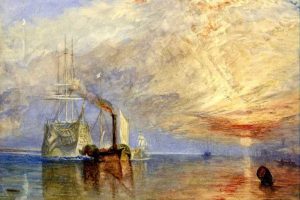
Codd’s copy of ‘The Fighting Temeraire’
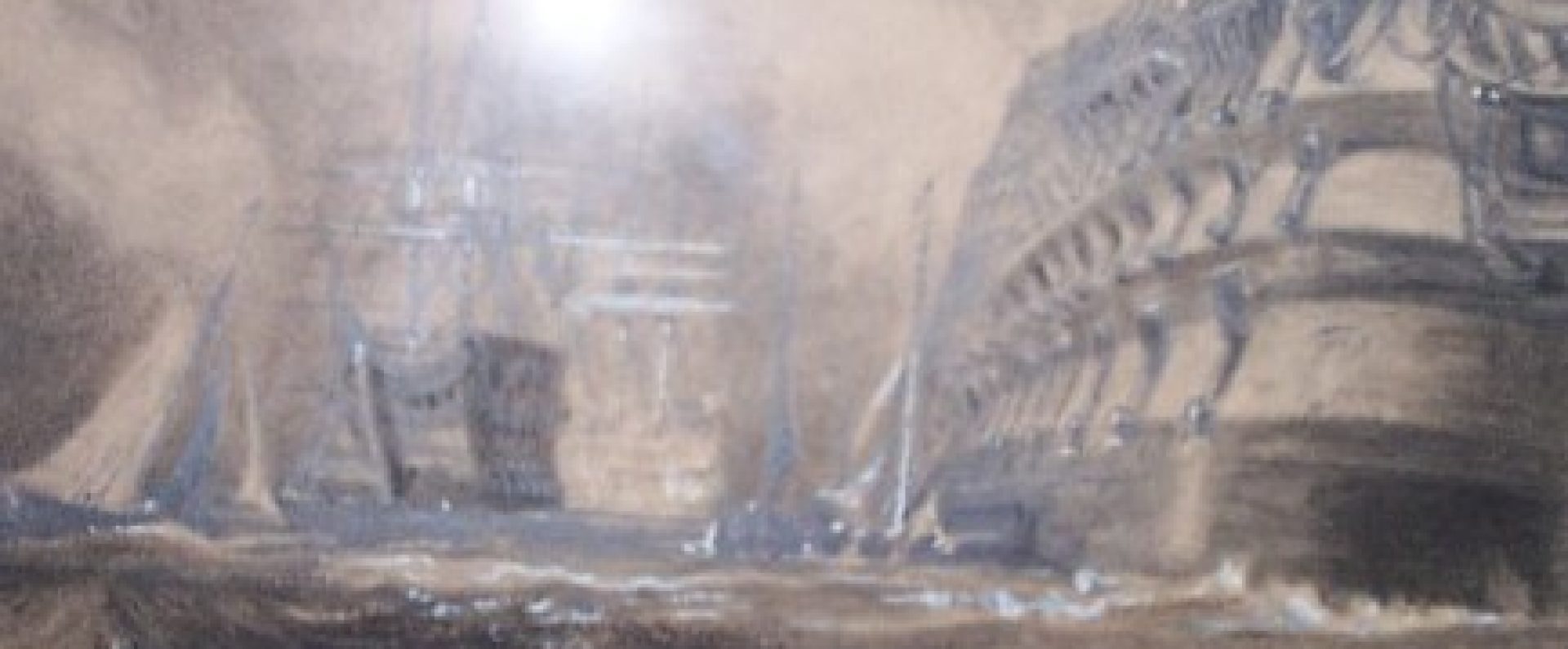
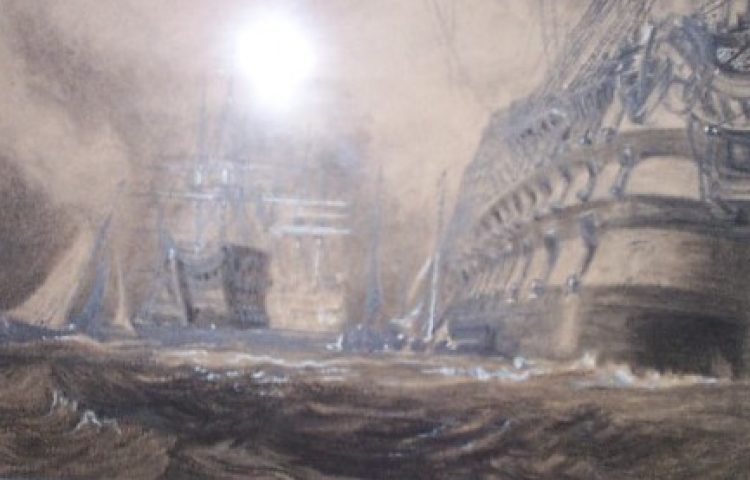
Spectacular though I think it is, The Fighting Temeraire is not the most interesting of Codd‘s copies. A First Rate Taking on Stores (detail shown above) was painted by Turner in 1818 while staying at Petworth House, the home of his patron, 3rd Earl Egremont. The picture was painted on a single day between breakfast and lunch at the request of the earl to illustrate the size of a large warship (similar to Nelson’s Victory) and is an example of the artist‘s almost photographic memory. Strangely, although the original picture is watercolour, Codd’s copy is black and white, rendered in charcoal, in contrast to his almost forensically detailed reproduction of Turner‘s other pictures. Whatever the reason for his change in medium, I think Captain Codd’s copy is a splendid picture in its own right. In some respects it is more striking than the watercolour, whilst retaining all of the detail in the original image, thus combining copying with his own take on artistry.
It is important to note that Codd made no great claims for his pictures; indeed he is almost too self deprecating in his comments quoted in Turner in Bridport and, similarly, I certainly do not wish to give the impression that I think his copies rank with the original masterpieces.
The full story of how the son of a Dorset clergyman became a professional soldier, traveller, amateur artist, copyist and museum benefactor is remarkable and must not remain unpublished.
Tony Pike- Volunteer
Sources
Bridport Past by Gerald Gosling, (Phillimore and Co., Chichester, 1999)
Turner in Bridport by E Hicks, G Willis, B Parker and S Scriven. Copies available in the museum shop.
The story of Captain Codd’s early life can be found in his memoir Life in Beaminster 1864 – 1910 edited and published in 1969 by J Stevens Cox, Toucan Press, Guernsey. Out of print
Britains Greatest Painting, popular vote orgainised by BBC Radio 4 Today programme in conjuction with National Gallery, September 2005
All of the information included in this article is correct to the best of our knowledge. However, if you believe anything is incorrect, or would like to submit further information, then don’t hesitate to get in touch.