

Signet Rings and Dolphins
Volunteer Sue Wilson explains more about two of the star objects in our archaeology collection.
Volunteer Sue Wilson explains more about two of the star objects in our archaeology collection.
Does anyone remember the dolphin ring in Rosemary Sutcliff’s Eagle of the Ninth series of books? It was first owned by a Roman soldier and passed down the family over the centuries. We have two such rings from the Waddon Hill collection in the Museum. They are tiny, only about 10mm across, and beautiful, but you need a magnifying glass to see them properly.
The stones are known as ‘Intaglios’ and were well known in the Roman world. They were personal signets, made from a small gemstone, with a design cut into the surface by skilled craftsmen, and usually set in a ring. They were used to seal important documents and objects by making an impression on soft clay or wax. Wearing a signet ring showed that you were literate, and had some wealth and influence. Many have been found across Roman Britain, in towns and military sites alike. Perhaps, at the Waddon Hill military fort, they were used to control access to store rooms and stores, to cut down on pilfering.
They were not usually buried with their owners and may well have been passed down to family members. They had an enormous choice of images: gods and goddesses, sacred images, myths and mythical beasts, animals and portraits. The choice of motifs would have had a personal significance to the wearer and, as it was used as a personal seal almost like a signature, this makes sense. The design would also be recognised by friends and colleagues of the owner.
The first intaglio, made of burnt sard (a hard dark brown cornelian) ‘depicts a Capricorn carrying a palm leaping over the prow of a warship, with a dolphin and a globe. It may have had additional significance to its wearer since it is thought that the camp belonged to Legio II Augusta, who used Capricorn as their emblem.[1] [2]’
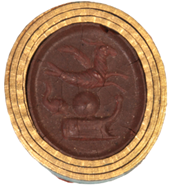
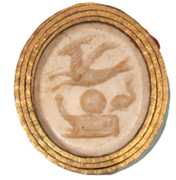
The symbolism is important. As well as Capricorn being the legion’s emblem, the others are military, showing victory and marine victory. So, was this commissioned just after the invasion for one of the senior officers and sent to him in Britannia? Which he then lost!
Our second intaglio is Cupid sitting astride a dolphin. This is even tinier, about one centimetre across. It’s made of blue glass, which was commonly used to imitate gemstones and dated to the mid 1st Century AD. This would have been cheaper than using a gemstone and perhaps may have belonged to a less well-off legionary. It has been carefully cleaned and mended by our specialist conservators before being displayed.
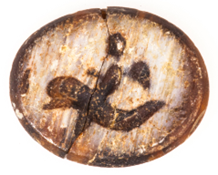
Dolphins were a popular animal motif and symbolised the sea, particularly Neptune. The Cupid riding it represents the soul travelling across the sea to the Isles of the Blessed and so the ring could have been associated with funeral rites.
Sue Wilson- Volunteer
References
Webster 1965 p144 & 145 fig 6 item 7 Dorset Natural History and Archaeology Society Proceedings
Henig, M, 1971 Roman Gems in Dorset in Proc DNHAS vol 93
Henig, M 2007, A Corpus of Roman Engraved Gemstones from British Sites, BAR publishing Oxford
Marshman, IJ 2015 Making Your Mark in Britannia, an investigation into the use of signet rings and intaglios in Roman Britain. PhD Thesis 2015 University of Leicester. Available online.
Sutcliff, R 1954 The Eagle of the Ninth (fiction)
[1] Marshman, IJ, 2015
[2] Henig, 2007a
All of the information included in this article is correct to the best of our knowledge. However, if you believe anything is incorrect, or would like to submit further information, then don’t hesitate to get in touch.