The Chideock Egg Lady
Frances Colville explains more about Chrissie Squire and her unique role in World War I.
Frances Colville explains more about Chrissie Squire and her unique role in World War I.
Members of the Squire family appear frequently in the story of 20th Century Chideock- but one member – Christina or Chrissie as she was more normally known in the family and village – stands out. Born in 1894 she was the youngest of six siblings and like her brothers and sisters attended the board school in Chideock.
Later in her life, we hear about her participation in village entertainments as a raconteur of tales and jokes, of her contributions (baked, painted and knitted) to the Melplash Show, and her reputation as a friendly and efficient landlady running a popular guest house at Glendale (now Hollow Cottage) on North Road. Many of the village inhabitants knew her as ‘Aunt Chrissie’ whether she was related to them or not. She never married and had no children. So the information we have about her comes from her niece Joan, another Chideock resident for much of her life and daughter of Chrissie’s elder brother William, and also from her great-nephew Colin, grandson of Joseph.
It is from the information passed to the Museum by Joan that we learn about a particularly fascinating episode in Chrissie’s life. For the duration of the First World War she was the only one of the siblings permanently in Chideock. At the outbreak of war, she was 19 and living with her parents, at Glendale. Her brothers, Joseph, Eleazar and William went off to war and it is not difficult to imagine that Chrissie may have watched them leave and wondered just what her own role should be. Did she feel frustrated that she was unable to join in the fight herself or did she relish the opportunity to take on some of the work of the absent men around the estate? Like other women at the time, she would have been kept very busy with the addition to the normal routine of extra war time activities such as bandage rolling, and knitting socks and other warm garments to supply the soldiers, and she would undoubtedly have been involved in helping to increase the levels of food production.
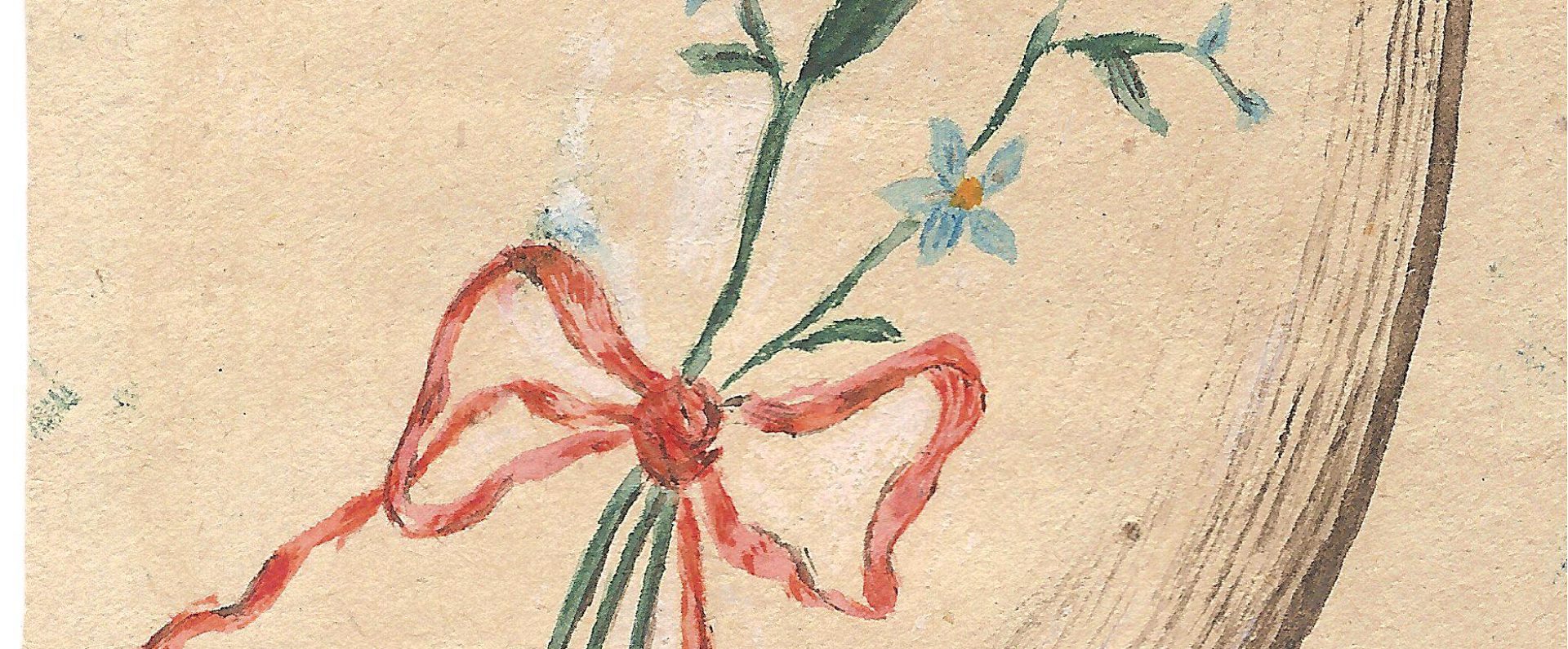
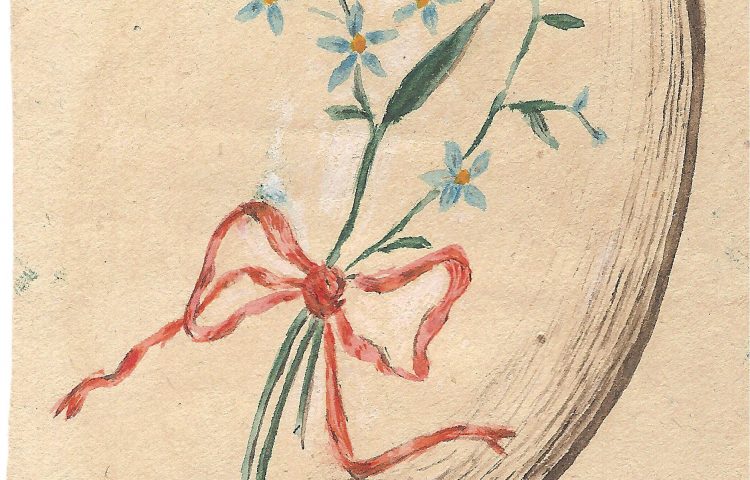
However, Chrissie was not content just to do the minimum, and she found a way of making a unique contribution to the war effort. She became involved with the National Egg Collection. This was an initiative set up in the early days of the war under the patronage of Queen Alexandra to collect eggs and distribute them amongst wounded soldiers in France to provide additional and much needed sustenance. The scheme continued throughout the war and an astonishing number (well in excess of 20 million) of eggs found their way into hospitals over the course of the four years. 64,000 passed through the collection centre in Bridport Town Hall and of these Chrissie certainly contributed hundreds, as we know from various receipts she saved and awards she was given. More importantly, she personalised her eggs, putting her name and address on to them, painting intricate little pictures and sometimes adding a poem or an encouraging word. In return she received many letters from soldiers thanking her, and giving her snippets of information about their lives. These letters were saved by Chrissie, and then by her niece Joan, and are now owned by the Museum.
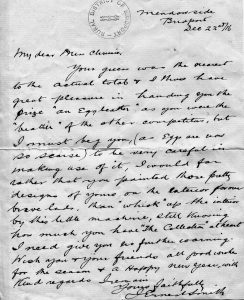
From the letters we learn that Chrissie painted a variety of different pictures on her eggs. We hear about sprigs of heather, flowers, black cats with long tails, the Union Jack and the French flag. We know some of the poems she wrote and can deduce that she became very skilful at fitting quite a number of words onto each eggshell. Here is one example received by a wounded soldier in July 1918.
“Tis but a simple egg I send
But kindest thoughts attend it
And may God bless with happiness
The friend to whom I send it”
We know that often there was a lottery or draw to determine which man in a hospital ward would be lucky enough to receive the decorated egg. And we know that some of the soldiers either kept the whole egg rather than destroying the paintings or managed in some way to blow the egg out and preserve the shell. We don’t know if any of these eggs are still in existence.
What do the letters tell us of the soldiers themselves? Some are written in pencil, some crayon, and some with pen and ink. One or two are typed. Some are beautifully written and very easy to read, others more difficult to decipher. Sometimes the writing is very shaky and often it is clear that the letter is written by someone lying down in bed, ill or injured or both. In most cases the use of English is excellent, though one or two are obviously from soldiers who are not very literate but still take the trouble to write to say thank you.
The letters are written by men of varying ranks and of several different nationalities including British, Australian and Canadian. Some come from hospitals in the UK and most from France. Together, they paint a fascinating and often heartbreaking picture of life as a soldier in the First World War. We learn of terrible injuries and illnesses borne with extraordinary courage and dignity. We read about the horror of the battleground, the grim and unrelenting hardship and tedium of life in the trenches, the comradeship of fellow soldiers, the kindness of nurses. Grimness pervades all the letters, despite obvious attempts to hide the worst from the folks back home. Here are just a few examples:
A Gunner from the Canadian Artillery writes in January 1916 “I have a poisoned compound fracture just below R. knee joint. Am doing very well now. And they expect to save my leg. I hope they do too. Was hit in 5 other places but nothing serious. This lying on one’s back day after day, not able to move, certainly does get on your nerves. It won’t last for ever tho’ that’s some consolation”.
Another soldier from the same hospital in France says “I have been out here 11 months. I have seen life and death, brave sturdy lads in the fullness of manhood marching to take their allotted places in the firing line. I have seen them come back. No picture ever painted, no dreams could make you realise the sight that meets your eyes no thunder claps was ever known when you are between the fire of hundreds of big guns. The scene is one of utter desolation it gives you an idea of what would be the end of the world.”
J Sheldrake writes in March 1916 that he was standing in his trench when a shell burst behind him which ‘brake (sic) both bones in my right shin and Brake one of them in two places and A nasty wound in my Right thigh” Private Norman has managed after great difficulty to be hospitalised back to Cambridge and writes in November 1915 “I came to England day before yesterday on that hospital ship that has been sunk, I was wounded September 25. I was in a charge but I am not much good now as a piece of shell went through my lung. I have only one left now and I think I shall be in hospital for months yet if I get over it as the shell is still in me…………….I have been very near it”.
Many of the letters give us a strong sense of the loneliness of the soldiers, especially those who are far from home, and their gratitude that someone has taken the trouble to think of them. “I must say it makes every brave Tommy proud of himself when even the young Ladies at home are sending their names and addresses on Eggs to them” Often the writers ask Chrissie if she will write back to them or send a photograph or even if they can visit her next time they get back to ‘Blighty.’ Sapper Ted Owen, a Canadian, thanks her for ‘the little painting which all say was just fine………..I’m hoping to get across the water soon so perhaps I may be able to thank you personally”. Corporal Heatley writes on August 14th 1916 “I simply admired the verses on the eggs and more so admire the sender so please answer my letter, and I will not forget you in the future.” He signs the letter ‘Your soldier boy”. Private David Davis writes from the hospital in Boulogne in November 1916 “I should very much like to make your acquaintance when I get back to England. I should very much like to receive a photo of you……I am a Londoner by birth…..but I will certainly come to see you when I get back if you don’t mind. I haven’t a young lady yet, but I should certainly like one. I am a rather nice looking young fellow of 22, which reminds me I should like to know your age when you next write”.
They were of course almost exactly the same age, but sadly we don’t know whether Chrissie did write back.
Indeed we can only speculate whether Chrissie entered into correspondence with any of the writers or even whether she went further and met up with any of them, or embarked on a relationship. It seems reasonable to assume that she may at the very least have written a reply to some of those who asked her to do so. There are two letters from one soldier so it is likely that she wrote to him in response to the first. And if she did this for one soldier she may very well have done it for others. But we don’t actually know. We do know for sure that she never married. But we can only guess that this may have been because she lost a loved one during the war.
Frances Colville- Local Historian and Writer
Find out more:
All of the information included in this article is correct to the best of our knowledge. However, if you believe anything is incorrect, or would like to submit further information, then don’t hesitate to get in touch.