

International Women’s Day (IWD) on 8 March every year is a moment to express solidarity with women across the world and to celebrate women’s achievements in support of one another.
In 2022, days into the war in Ukraine, it seems particularly appropriate that we celebrate the life of one Bridport woman who galvanised the town to provide support and hospitality to refugees fleeing from another terrible conflict, the Great War.
This IWD and during Women’s History month we celebrate the practical solidarity of Tryphena Cornick (1871-1925)

As her Cornish name shows, Tryphena Sandercock was born in Jacobstow, a village in North Cornwall, in 1871. Her father was a shopkeeper and farmer. She seems to have worked for a living after leaving school and aged 20 was boarding in Launceston, working as a stationer’s assistant. In 1899, Tryphena married her cousin William G.F. Cornick in Camelford, Cornwall. She then joined her new husband in his home town of Bridport. William was 9 years her senior and already well-established in Bridport. In the 1901 Census he was described as Grocer Shop Keeper & Wesleyan Preacher. The family’s jam manufacturing business was widely advertised in the town.

In 1900, Cornick had taken over the business of a rival grocer and it was in the 12 rooms over this shop at 10 West Street that Tryphena made her home. She soon appeared in the local press supporting activities in aid of the Wesleyan Church – an interest she shared with her new husband. In December 1900 she ran a refreshment stall at the conversazione and sale of work held at the Wesleyan school room in aid of the Church Renovation Fund (WG, 7.12.00).

The Cornicks were civically engaged and active in different ways within the town. This they shared with some of their immediate neighbours. Next door to them in West Street lived one of the first women in the town to be a Poor Law Guardian, Euphemia Northover, while at no.24 lived John and Agnes Suttill – she was to become Bridport’s first woman town councillor in 1921. Agnes and Tryphena had much in common: they both married into Bridport; married relatively late for the time (Agnes was 38, Tryphena was 28); their husbands were Councillors, had Liberal politics and were non-conformists. Neither couple had children. It is not clear if they were friends although they would have known one another in the small world of the Bridport couples who dominated the town’s civic organisations. As the all-male Town Council selected its Mayor each year, another local woman stepped up to become Mayoress. Agnes Suttill was Mayoress from 1911 to 1913 and she was followed by Tryphena who also served for 2 years when her husband was Mayor. She was therefore Mayoress at the outbreak of the Great War in 1914.

William Cornick’s shops

A profile of the new Mayor, William Cornick (Western Gazette, 14.11.1913)
The German invasion of Belgium in 1914 which began the Great War created many refugees, many of whom fled to Britain. It was in local towns, villages and neighbourhoods that the offers of hospitality were made and the arrangements devised to pay to house, feed and support refugees of all ages who had fled with nothing. No system existed in 1914 to deal with such a large number of destitute foreigners, many of whom could not speak English. By the end of 1914, nearly 100,000 Belgians had crossed the Channel. In total, during the war, over a quarter of a million destitute Belgians came to Britain, although there were never more than 175,000 in Britain at any one time. About one in three lived in greater London but towns and villages across the country offered accommodation and financial support.
Bridport set up its own Belgian Refugee Fund to raise money and to make preparations. The Mayor led the financial appeal while his wife, Tryphena as the Lady Mayoress, took the lead in a committee of local women who made all the practical arrangements to receive and support an unknown number of destitute Belgians, particularly women and children, for as long as the need existed. In August 1918 Tryphena Cornick was awarded the Medaille de la Reine Elisabeth by the Belgian royal family in gratitude for her leading role in Bridport’s warm response to Belgian refugees. She was one of only 7 Dorset women so honoured.
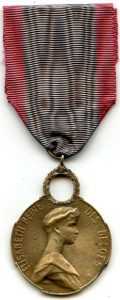
At the public presentation of this medal the current Mayoress, Jean Edwards, who had been part of the refugee committee, spoke warmly of how Tryphena ‘brought her powers of organisation to bear in this relief work, as there had been no previous experience of the kind’. Mrs Cornick had done the spade work and drudgery behind the scenes when the town opened their hearts and homes to the Belgian refugees. She had turned her home into a second hand shop for old clothing, added to which a huge volume of vegetables were regularly left at her house. Jean Edwards said, to laughter from the audience, ‘housewives knew what it meant to have people wandering about the house to see old clothes and to have potatoes and other vegetables dumped down upon clean floors’. Mr Cornick had provided his grocer’s van for carrying furniture and food to the temporary homes of the Belgians. Tryphena and her committee saw their work as a moral responsibility: the town had invited these refugees to come to Bridport and it was felt that ‘they should be able to live comfortably among us’. When Tryphena heard about the medal she was to be awarded, she wanted to share it with the others who had worked alongside her. However, Jean Edwards said that Tryphena ‘had worked far more than any of the rest of them, and thoroughly deserved the honour of this award’. Tryphena reportedly felt that whatever had been achieved she had only worked in co-operation with other ladies on the committee and would have felt ‘more comfortable if every other lady who worked so nobly with her could share in her honour. It just happened that, by the kindness of their friends in Bridport, she was Mayoress at the time this work was started’. Other reports emphasised the zest with which she had undertaken this work. There is humility here as well as collaborative work expressing solidarity with deeds not words (to steal the suffragettes’ slogan). Tryphena Cornick was one of the Bridport women who raised the money and made the arrangements to provide a sustainable welcome right across the war to the destitute women and children who were forced to flee Belgium in 1914 and who were given sanctuary in Bridport.
When Bridport and the Great War was published in 1923 the patriotic work of the town’s 4 War Mayors was recognised and the support of their Mayoresses was acknowledged. ‘The new war conditions …. brought upon Mr and Mrs Cornick an unprecedented amount of work, for, as Mayor and Mayoress, they had to take the lead in organising local working committees, flag days, entertainments, and other means of raising funds and sending comforts to our soldiers and sailors fighting the enemy. Everything was of course new, but the organisation was successful in every respect and beyond all praise (Rowson, pp.41-2) Mrs Cornick was singled out for ‘the devotion which she displayed in regard to the refugees’ (p.47).
Tryphena Cornick died very suddenly in January 1925 at the age of 53. The grief in the town was palpable. Most of the business premises were partially closed to show respect on the day of her funeral and the Wesleyan Church was crowded with mourners. This was not just because she was the wife of a leading citizen, although enormous sympathy was expressed towards William and the family. The Western Gazette’s headline to a long report of her funeral was ‘Death of Mrs Cornick. A War-Time Mayoress’ (16.1.1925). Here she came alive as a Cornish woman with a wide circle of friends who was connected with most of the philanthropic bodies in the town, who was always willing to give help and advice. It was as a war-time Mayoress that she was best remembered, with a particular interest in the Belgian refugees. The medal from the Belgian royal family was referred to as was her work forwarding comforts (clothing and food) to the men at the front. It was noted, ’throughout her long association with Bridport she has readily taken a leading part in anything to advance the welfare of the borough’. After the war she was the town’s Probation Officer, taking ‘a great interest in doing all she could for the children and girls who had made mistakes in their early lives’. She took a deep interest in everything connected with the Wesleyan Church, particularly the Wesley Guild but ‘was equally energetic in the affairs of the town’. At her funeral it was said, ‘she combined splendid business ability with a wise and kindly judgement, which gave her a power in many of the affairs of this place in which she lived. Her public work has been greatly valued, and she was beloved by all who knew her. … A great many people who have visited her home …. have always realised her wonderful kindness and the thoughtfulness extended to the smallest details in regard to the hospitality which she always rendered. She will be missed not only by a few, but by all classes in this town, and there are some of us here who feel very deeply that we have lost a true and faithful friend.’ We might all wish that this could be said of us.
So, Tryphena Cornick is a worthy woman to remember in Bridport on IWD. And in what is now a rights-respecting town, it is also interesting to see it was observed of Tryphena that she was ‘broad-minded and very tolerant of the views and opinions of others…. she ever rejoiced in work which all good people did, whatever communion they might belong to.’ Let us remember Tryphena Cornick who made a difference in Bridport to the lives of people, particularly women, irrespective of what place they came from. There are many ways to express solidarity: one way is to provide practical support to refugees fleeing war.
This portrait of Tryphena Cornick draws on the genealogy website findmypast.co.uk: Bridport News (microfilm soon to be available at Bridport Local History Centre + from britishnewspaperarchive.co.uk for digitised copies up until 1900) + Western Gazette (britishnewspaperarchive.co.uk).
Professor Karen Hunt, March 2022


