The Langdale Axe
Archaeology volunteer Sue Wilson tells us more about an object she feels is a window on a distant world….
Archaeology volunteer Sue Wilson tells us more about an object she feels is a window on a distant world….
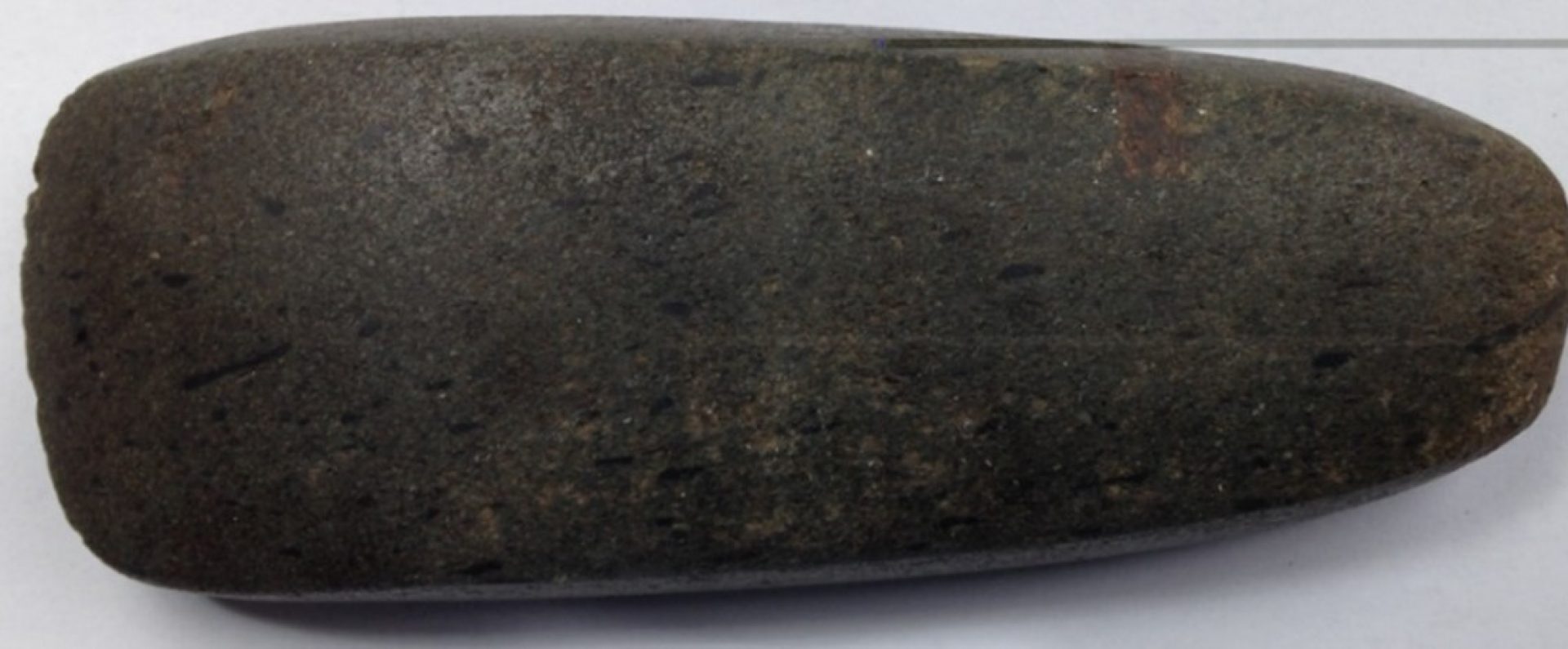
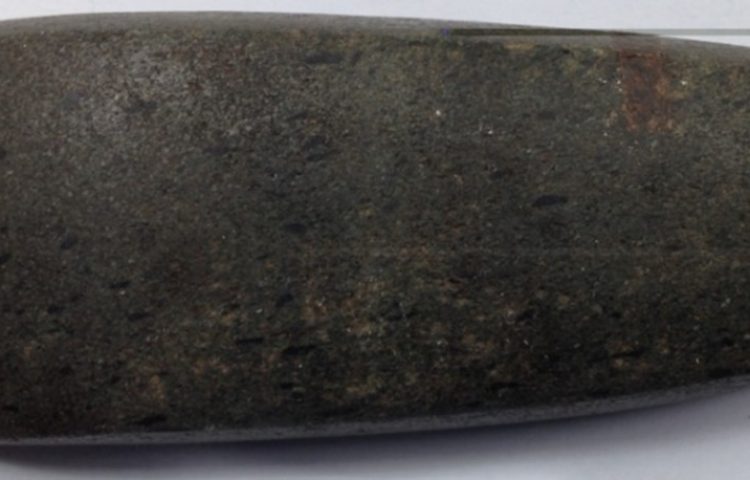
This is one of my favourite objects: a hand axe volcanic greenstone. It is no ordinary axe – it has been beautifully made and then polished to a fine finish, unlike most tools of that time. It was found somewhere in South Dorset. We don’t know much about how it found its way to Bridport Museum, but it tells its own story.
It was made in the early Neolithic period – around 6,200 to 5,800 years ago. During this time new people arrived from the continent. These people had a profound effect on the landscape as they cleared woodlands, built settlements and developed farms. They also developed more sophisticated stone working techniques, and identified better raw materials.
This axe came from a very special place – Great Langdale. The ‘axe factory’ was one of several, high up on Pike O’Stickle, on a rocky outcrop, beside a steep drop and difficult to reach. The same stone could have been found at the foot of the slopes and would have been far easier to mine. But this site was chosen- perhaps it was a significant place because of its inaccessibility, and the stone from there carried the character of the place with it.
Many Langdale axes have been found across Britain. Most were dug up in the East of the country, particularly Lincolnshire and North Yorkshire, the furthest from the original source. There were other axe factories in Britain and Ireland, often in remote places, away from settlements. They too had been carried far from their origin.
Gabbro axes from the Lizard in Cornwall travelled to South East England. Porcellanite polished axes from Tievebulliagh, a mountain in the Glens of Antrim, in Ireland have been found as far flung as the Outer Hebrides to the Channel coast. These patterns of distribution say something about the routes people travelled and traded on. They must have moved not only on land, but probably more commonly by sea and river. No doubt other commodities were brought in this way, but the axes’ origins can be more readily identified than other goods.
Axes came from even further afield; Jadeite axes from the Western Alps (some 140 are known in Britain and Ireland) were brought here, probably via river routes and across the Channel. This demonstrates an immense amount of cross channel exchange and communication.
These outstanding axes have been acquired, exchanged or traded, and passed from traveller to traveller. Perhaps at meeting places, for or celebration or ceremony, or as a gift or to cement a relationship.
Our Langdale hand axe tells us much about our Neolithic ancestors: the mobility of people at that time, their skills in making beautiful tools, their understanding and knowledge of distant places.
Sue Wilson- Archaeology Volunteer
(adapted from an article original published in The Bridport Times)
All of the information included in this article is correct to the best of our knowledge. However, if you believe anything is incorrect, or would like to submit further information, then don’t hesitate to get in touch.