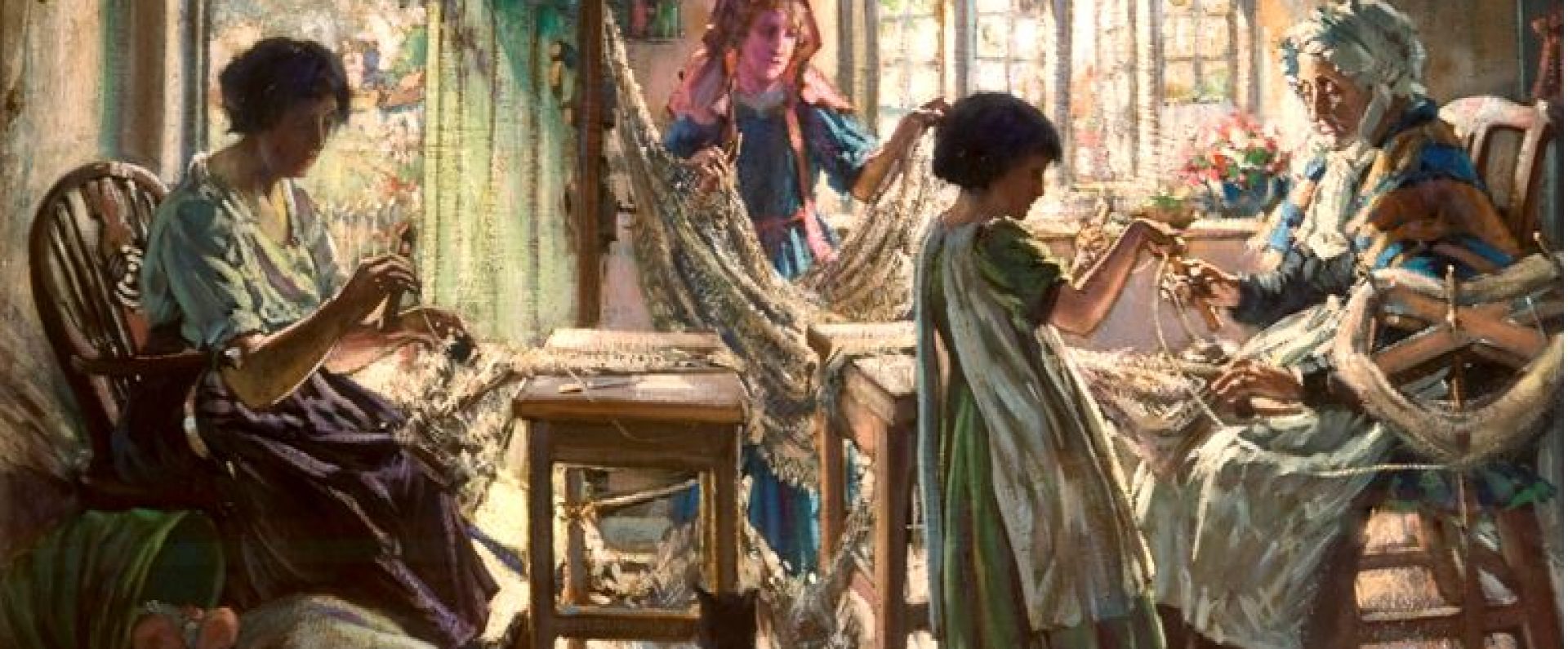

Net Braiders by Fra Newbery (1855-1946)
Director Emily Hicks shares what she loves about Fra Newbery’s painting.
Director Emily Hicks shares what she loves about Fra Newbery’s painting.
To me, this painting is one of the treasures of Bridport Museum’s collection. I love it firstly on quite a simple level: it’s a very attractive work to look at: harmonious colours and the use of light create a sense of tranquillity and ease. I have a personal interest in 19th Century painting; particularly that of the Pre-Raphaelites. Although Newbery was only just born when the Pre-Raphaelite Brotherhood were starting up, it has always struck me that he must have been influenced either directly or indirectly by them. Like them, he often painted working people, and he seems to have inherited their love of intense colour.
The painting depicts a cottage interior with 3 generations of one family braiding nets. ‘Outworkers’ in the town’s netting industry were almost always ladies, and they worked at home, usually to supplement the main household income. On the right-hand side is a ‘Bridport Cross’, which holds the twine. The older girl supports the net which is hooked onto the front door, whilst the younger girl helps her Grandmother to load the braiding needle. The needles came in different sizes, rather like knitting needles. We have hundreds in our collection, many on display in the Museum. I couldn’t say what type of nets they are making, but it is likely to be fishing net or garden net of some kind. Also on display in the Museum is an Outworkers ledger from around the time that this work was painted. Each page is dedicated to a different woman and describes what she was making and with how much twine she used.
When you come to consider the painting for longer, and start to put it into context, you realise that perhaps this is actually a somewhat idealised view of the industry. The summer sun shining in through the cottage door and the evocative Dorset bonnet create rather an idyllic scene; the reality was probably somewhat different. Wages for outworkers were low, and just imagine trying to braid very fine and intricate nets without electric lighting. It must have strained your eyes and made your hands rather sore.
What about the artist himself? Francis Henry Newbery was born in Devon in 1855 but came to live in Bridport at the age of 3. He went to the Bridport General School (the building next to Bridport Primary School) where the headmaster encouraged and supported Francis’ wish to study art seriously.
Fra (as he liked to be called) later studied at the Bridport School of Art. This was on the third floor of the Literary and Scientific Institute, now refurbished as the LSi. After he qualified he became an art teacher here for some years. He later moved to London and then became Director of the Glasgow School of Art in 1885. He is widely acknowledged to be a key figure in the promotion of the work of Charles Rennie Mackintosh and the Glasgow School.
Newbery retired back to Dorset, settling for his retirement at Corfe Castle in 1921. Newbery never forgot Bridport, and as a way of saying thank you he painted a series of pictures which are hung in the Bridport Town Hall. In his retirement years he redesigned the interior of Bridport Town Hall and painted the murals which include the famous ‘Spirit of Bridport’.
Throughout his life Newbery’s driving force was “to make art more readily available to a wider public, attempting to relate it to their daily lives and to celebrate the traditions of the specific localities in which the works were sited”.
The painting is on permanent display in the Museum. You can also discover this and more of our collection on the fabulous Art UK website.
Emily Hicks, Director
(adapted from an article original published in The Bridport Times)
All of the information included in this article is correct to the best of our knowledge. However, if you believe anything is incorrect, or would like to submit further information, then don’t hesitate to get in touch.