
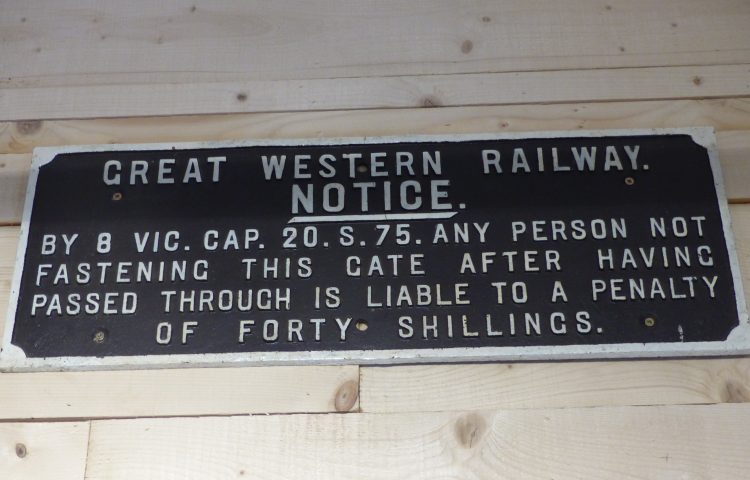
Bridport Railway Sign
Volunteer Jon Smith tells us more about his favourite Museum object…
Volunteer Jon Smith tells us more about his favourite Museum object…
I’ve always been interested in the small and ‘everyday’ side of history, so, as a fan of all things to do with railways, when I joined Bridport Museum as a volunteer, I was immediately drawn to the display in the upper gallery dedicated to the Bridport Railway Line.
One of the items on show is a cast iron oblong notice which reads, in block capitals
NOTICE -. BY 8 VIC. CAP 20. S.75 ANY PERSON NOT
FASTENING THIS GATE AFTER HAVING PASSED
THROUGH IS LIABLE TO A PENALTY
OF FORTY SHILLINGS.
You’ve probably guessed by now that this notice referred to a gate which led to a pedestrian path across an active railway line, and the financial consequences of not fastening it. Forty shillings are the pre-decimal equivalent of two pounds and the average weekly wage n 1845 (why I’ve chosen that year will become apparent) was approximately ten shillings (50p). Allowing for inflation the fine would have been the equivalent of £240 in 2020.
That’s all straightforward, but what about the “8 VIC. CAP 20.S.75” part of the notice? Like so many things in history, once you understand the abbreviations and the historical context, contemporary notices and writing can be surprisingly simple to figure out.
The Law regarding trespassing on railways was passed in the Parliamentary Session of the 8th year of Queen Victoria’s reign, 1845. The specific law regarding trespass was Section 75 of the 20th Chapter of the law.
There is one burning question in my mind though. In a time when approximately 30% of the adult population was illiterate, almost a third of the population wouldn’t have been able to read, let alone comprehend the warning! Perhaps they realised that leaving the barrier between a mechanical monster and safety open might be dangerous?
Its’ a simple real life everyday thing and knowing what it means is not only personally satisfying, but more importantly, is an historical nugget of information that I can pass on to enquiring visitors, which is surely a large part of being a Museum volunteer.
Jon Smith- Research Volunteer
All of the information included in this article is correct to the best of our knowledge. However, if you believe anything is incorrect, or would like to submit further information, then don’t hesitate to get in touch.