
Bridport and Refugees
Professor Karen Hunt takes an in-depth look at the history of refugees coming to Bridport
Professor Karen Hunt takes an in-depth look at the history of refugees coming to Bridport
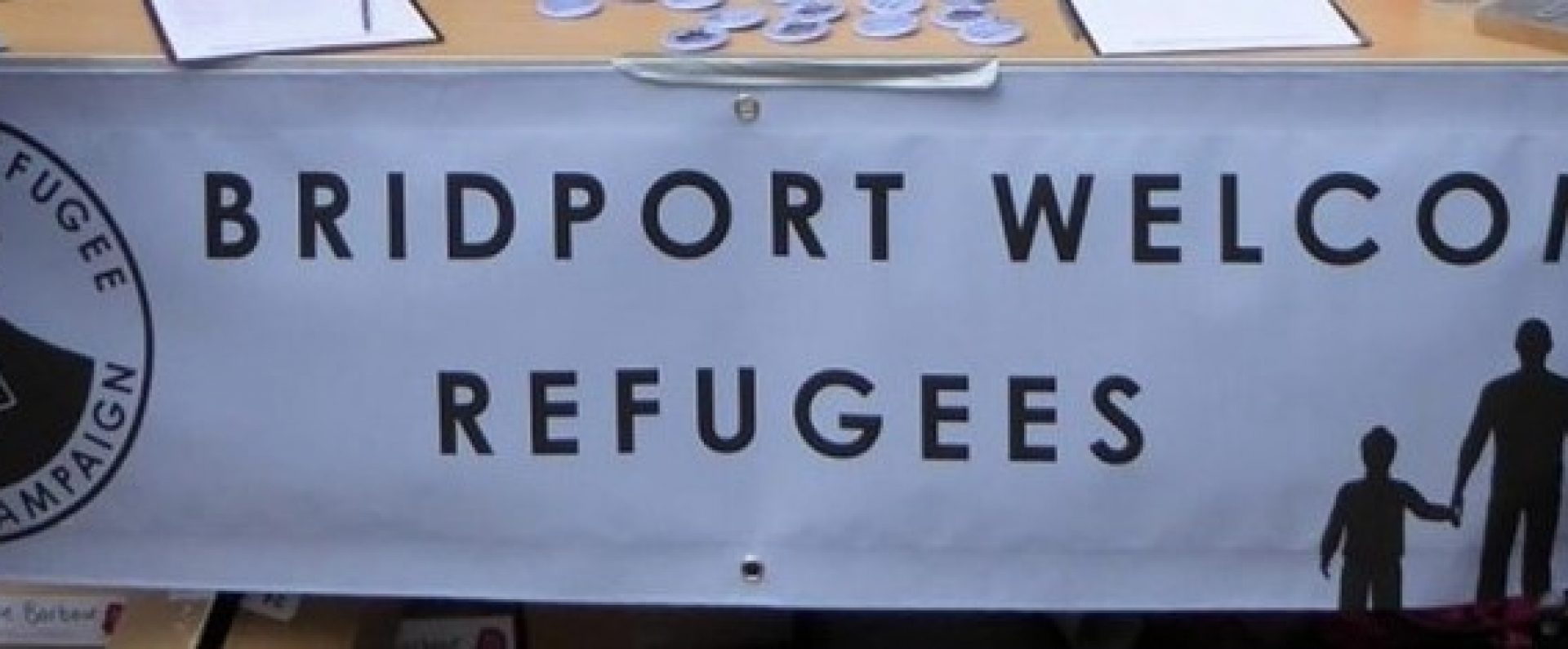
In 2020 a new group set up its stall in Bucky Doo Square. Their banner proclaimed: ‘Bridport Welcomes Refugees’. The Bridport Refugee Support Campaign is raising money to bring a refugee family to live in Bridport through the Home Office Community Sponsorship Scheme. You may have bought their Christmas cards designed by local artist Hugh Dunford Wood. They are also looking for practical support to make a refugee family welcome: painting and decorating the house the family will live in, helping the family to improve their spoken English, taking them shopping and befriending them. Barry Lovejoy, chairman of BRSC, told the Bridport News: “Bridport has a history of offering support”.
So, I wondered, what can we learn from how Bridport people responded to refugees in the past?
Over the years, Bridport people have been generous to funds that sought to support refugees suffering abroad. One cause that benefited was the Bosnian and Herzegovinian Fugitive and Orphan Relief Fund, administered by Miss Johnston and Miss Irby, which appealed for donations in the Bridport News in 1877 (BN, 14.9.1877). At the end of the nineteenth century the plight of Armenian Refugees moved local people, and the Bridport branch of the British Women’s Temperance Association made a collection for them at a public meeting held at the Town Hall (BN, 30.10.1896). The meeting was told how people in nearby Weymouth had already despatched two large bales of clothing, as well as a little money, to aid the work of the President of the BWTA , Lady Henry Somerset, who was working amongst Armenian refugees in Marseilles.
Conflicts around the world continued to create refugees. In 1899, Bridport’s Mayor, W.E. Randall, opened subscription lists in various local banks for the Transvaal War Relief Fund (BN, 3.11.1899). At the same time, Fanny Pope of Cordova in Bridport called for contributions of clothing for refugees from the Transvaal. Lists were printed in the Bridport News acknowledging donations from many of the town’s leading figures with the sums given: William Colfox, High Sheriff, topped the list with a donation of £50 (the rough equivalent of £6570 today), while Miss Amy, Alice and Ada Hounsell each gave 1 shilling (the equivalent of £6.57 each).[1] The Hounsell young women were the daughters of Henry Hounsell, fishing net and twine manufacturer. Such public displays of generosity by leading figures in a community were a common strategy of many charities in the nineteenth century (and beyond). Within a month of her appeal, Fanny Pope had sent 5 bales to Cape Town, consisting of 743 articles of clothing from 100 local contributors (BN, 15.12.1899). She still had some money left and hoped to make up a second consignment. At the same time, Beaminster Parish Council decided to arrange house-to-house collections to support a number of causes including the South African refugees.
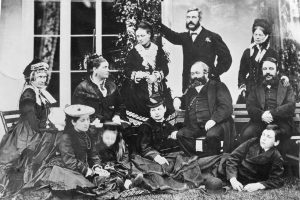
William Colfox with his wife Anna, and other family members
These are some examples of the ways in which local people responded to the many stories they heard of the plight of refugees abroad. In all these cases it was assumed that aid would be dispatched to the refugees wherever they were – usually far from Bridport. However the most famous example of Bridport aiding refugees was rather different. In this case, refugees were welcomed into Bridport and even into people’s homes. This is the story of the Belgian refugees in the First World War.
Before the arrival of Belgian refugees in 1914, there were a few isolated examples of refugees living in Bridport and the surrounding area. Colonel Robert Williams, Conservative MP for West Dorset from 1895 to 1922, was proud to note that one of his foremothers (born Jeanne Chasserau) was a refugee. The story he told in 1895 (BN, 10.5.1895) was that she lived at the family seat of Bridehead, Littlebredy, for forty years until her death in 1841 at the age of 102. She had arrived in England as a 14 year old fleeing from Niort, France where it was no longer safe for her as a Huguenot. Later, she married the wealthy merchant and banker, Robert Williams, and came to Littlebredy after he bought Bridehead in 1797. In 1841, she is recorded as living at Bridehead with family members and 20 servants. Later refugees were not so fortunate.
Britain’s welcome to refugees from Belgium in the opening months of the war has become a part of the stories the country has told itself during the centenary of the First World War. It was in local towns, villages and neighbourhoods that the offers of hospitality were made and the arrangements devised to pay to house, feed and support refugees of all ages who had fled with nothing. No system existed in 1914 to deal with such a large number of destitute foreigners, many of whom could not speak English. By the end of 1914, nearly 100,000 Belgians had crossed the Channel. In total, during the course of the War, over a quarter of a million destitute Belgians came to Britain, although there were never more than 175,000 in Britain at any one time. About one in three of the refugees lived in greater London – but towns and villages across the country offered accommodation and financial support.
In September 1914, Dorset formed its own relief fund for Belgian refugees. E.S. Reynolds of Bridport was its Hon. Secretary. He explained that the government had offered hospitality to thousands of victims of war in Belgium whose homes had been ruthlessly destroyed. The Local Government Board had asked the Dorset Committee to find out who would be able to provide accommodation for refugees, making clear that ‘they were not to be utilised as a means for obtaining underpaid labour’. This was a fear expressed in some parts of the country. Already refugees were being housed in Sherborne (Western Gazette, 25.9.1914) and, by the beginning of October, 20 Belgian refugees had arrived at Whitchurch Canonicorum (WG, 9.10.1914). Communities in Dorset made different decisions on how to respond to this appeal for help.
Not everyone was keen to provide hospitality for refugees or even to collect funds to support them. Readers of the Western Gazette would have seen the views of some who argued that charity began at home. A columnist purporting to write from the perspective of town dwellers argued: ‘It is surprising the ignorance that exists among the poorer classes as to the origin of the war, and even as to the reason the Belgian refugees have come over here. A great many poor people think they should never have come and grumble about the charity and kindness that is bestowed upon them.‘ (WG, 20.10.1914)
This did not seem to find an echo in Dorset. In the north of the county, the parishioners of Fontmell Magna felt that they were not doing ‘their share’ towards assisting Belgian refugees (WG, 13.11.1914). In Gillingham, they collected and despatched money and clothing to Alexandra Palace for the refugees housed there. Yet because the townspeople were to have significant numbers of soldiers billeted upon them, it was doubted whether accommodation could be found for refugees too (WG, 20.11.1914). Some smaller places did find room: East Chelborough took in a Belgian family with 5 children (WG, 25.12.1914). However, not everywhere was able to offer hospitality: the rural area around Poole had planned to offer 60 refugees board and lodging, but found they were prevented from doing so because the area had been designated ‘a prohibited area’ by the government on behalf of the military authorities. All ‘aliens’ – those who were not British citizens – were forbidden to enter the area because it was too near the coast. Yet many communities in Dorset did set up their own local committee to raise funds to house, feed and even find employment for refugees. Nobody knew in the autumn of 1914 how many refugees would come, what their needs would be and how long hospitality would be required. Many still thought that the war would be over by Christmas.
In West Dorset, a number of Belgian Refugee Funds were set up to raise money and to make preparations. This work was considered particularly suitable for women: Maiden Newton’s committee consisted of 8 women while in Bridport, the Lady Mayoress Tryphena Cornick took the lead. Quickly Canon Farrer of St Mary’s Church raised £47 (roughly equivalent to £5,546 today), while ingeniously ‘a little dog, belonging to Miss Cox of Bridge House, …. collected quite a large amount for the unfortunate Belgians’ (WG, 9.10.1914). By early November the first group of refugees was expected in the town. Two houses had been rented and furnished for their accommodation, a large number of articles had been given and more gifts were sought (WG, 6.11.1914). Individuals also offered help: W.S. Edwards (local net manufacturer and Town Councillor) offered his cottage in West Bay to the local committee to house 6 refugees. He hoped to provide everything that they would need free of cost for some months at least (BN, 11.9.1914). Edwards was not alone. The Mayor (W.G. Cornick, local grocer and jam manufacturer) said he ‘had received offers of homes for the stricken, suffering, and noble Belgian people …. who had lost so much, who had suffered so much, and to whom we owed so much’ (BN, 25.9.1914). As Bridport citizens are again thinking about how to provide hospitality to refugees (this time from Syria), can we learn anything from the practical steps taken by local people to welcome destitute Belgians to the town a century ago?
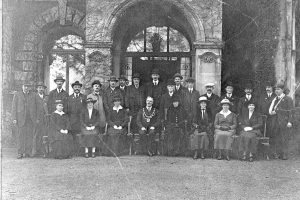
Mayor W.S. Edwards is seated in the centre of this group.
In October the Bridport News set up its Shilling Fund for the Belgian Refugees at the suggestion of the Mayor. In the name of the community, the paper made it clear that: ‘We have now in our midst large numbers of refugees who have fled to us homeless and poverty-stricken, and it is now for us to spare no effort in doing all that is possible to alleviate their sufferings and compensate them in some small way for the terrible trials which they have undergone.‘ (BN, 30.10.1914)
This was the kind of sympathetic language that was used of the refugees and their plight. They were ‘brave, unfortunate people, whose homes have been devastated, whose worldly possessions have been destroyed or stolen from them, and who have been driven out of their own land by the ruthless German barbarians who have overrun that once smiling and prosperous country’ (BN, 6.11.1914). Perhaps surprisingly, given dominant attitudes to foreigners before the war, there does not seem to have been hostility within Bridport to the refugees on the grounds of their nationality or their destitution, nor was the fear articulated that the refugees would end up being competitors in the labour market. This may be because many of the refugees were women and children. The first group were described on arrival at the end of November as ‘mostly women and girls, many of the women carrying babies in their arms while others carried bundles of clothes, buckets and other articles, all that they possess of their once comfortable homes’ (BN, 27.11.1914). These people were understood to be innocent victims of war whose sorry state deserved the kind of humanitarian response made by many Bridport people.
Belgian refugees came to Bridport because they were invited. Having fled from their homes in the opening weeks of the war, most were then held at reception camps such as at Alexandra Palace and at Earl’s Court in London. From there they were dispersed to permanent housing all over the country on the basis of invitations issued by local town and village communities who made clear what kind of hospitality they were in a position to offer. In the case of Bridport, E.S. Reynolds went to London in early November to make the necessary arrangements for the dispatch of 30 refugees to the town, which was offering 2 large houses specially prepared for the refugees – Alphington House, North Allington and ‘a very commodious residence’ in East Street (probably 67). In addition, a number of people offered to take 1 or 2 refugees into their own homes (BN, 6.11.1914). The anticipated arrival of the refugees was delayed so there was more time to make appropriate arrangements to welcome them. Initially it had been thought that the refugees would be taken as a group to the Town Hall where the Mayoress would provide them with ‘a bountiful tea’ as a public welcome to the town. This was then revised because of what was thought to be the refugees’ painful circumstances and their natural modesty as a people. As most of the refugees were Catholic, it was decided it would be better to take them directly to the Convent on Pymore Road. The Mother Superior had lived for many years in Belgium and was said to be familiar with Belgian habits and customs as well as the language. ‘Our Belgian friends’, as the Mayor called them, would then be taken in groups to their new homes.
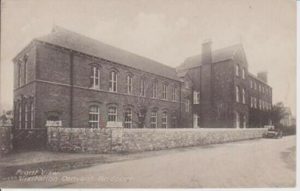
Visitation Convent, Pymore Road, Bridport (now demolished)
There seems to have been no hesitation that hospitality should be offered and that it should be the result of voluntary effort. As the Mayor said in support of the new fund: ‘It is most desirable that everyone should be prepared to give some weekly amount, however small, towards these Refugees who claim our earnest practical sympathy. Offers of furniture, bedding, crockery, etc, will be gratefully received by the Mayoress, as soon as possible and I shall be glad to receive at once gifts of money for this purpose.‘ (BN, 30.10.1914)
It was estimated that at least £6 to £8 a week (about £700-950 today) would be required for the maintenance of the families who were due to arrive in Bridport. Donations were already coming in, including £25 (today about £2950) from Miss Colfox (from one of the leading families in the town). All donations, whatever their size, were acknowledged in the Bridport News. On the 4 December 1914, days after the refugees arrived, the list included regular subscriptions such as from Mrs J.C. Palmer (wife of the owner of the brewery and member of the local Belgian Refugee Committee) who was to give 1 shilling (nearly £6 today) for 26 weeks. The largest donation was for £10 (£1180 today) from C.G. Nantes, the Town Clerk, while Mrs Gundry (from the family of one of the town’s largest employers) gave 5 guineas (nearly £620 today). These contributions were generous, but might be expected from the town’s great and the good; however what is striking is that this week, and in many subsequent ones, there were collections from working people. The girls in Messrs Gundry’s Warehouse gave 1s 5d, while the girls in Messrs Whetham’s Warehouse collected 1s 9d for the fund. Over the next months, collections were acknowledged from workers at Gundrys and at W.S. Edwards & Sons, including repeatedly from girls working in their company warehouses. By July 1915, the Bridport Fund stood at over £483. This would be worth nearly £51,000 today.
Fundraising took many forms apart from regular subscriptions and workplace collections: the proceeds of a football match were donated; there were entertainments such as a Mayor’s Concert held at the Drill Hall which raised £40; a lecture at the Wesleyan School (10s); donations from children and young people such as the Secondary School Christmas gift of £1 16s, General Boy’s School (6s) and collections made at the Unitarian Sunday School and at Allington Girls Sewing Class; sales of work such as that arranged by Mrs Gillingham at Burton Bradstock (£15 5s). The staff at one of the largest houses in the town, Coneygar (the home of the Colfoxes) made quite a sizeable donation with ‘other cheerful givers’ of £2 5s 6½d. The 1911 Census shows the Colfoxes employed 9 resident servants including a butler, housemaids and grooms. As with all workers’ donations, it is hard to know how cheerfully donations were made and whether there was pressure from employers. Certainly, most of the employers whose workers made collections were involved in the Belgian Refugee Committee, often through their wives. Yet the columns of the Bridport News suggest that local people, whatever their social class, continued to give generously with whatever they could spare even when there were competing wartime causes that were also appealing for funds. The continuing support of working people was one of the features of Bridport’s response to Belgian refugees. This was not the case everywhere.
People found all sorts of ways to support the local Belgian Refugee Fund. The jury at a coroner’s enquiry into the death of Major Digby of Cattistock, who had been knocked down by a train near Maiden Newton, made an unusual request: they asked that their fees be spent on Belgian Refugees as this was one of the many causes supported by Major Digby (WG, 30.10.1914). Others used the opportunity of a gathering for some other purpose to make collections for the refugees, for example an address by Mr Carpenter and a concert at the Adult School. There were also house to house collections, such as one throughout the Symondsbury parish which raised £6 6s 6d(WG, 20.11.1914). As time went on, the needs of the refugees were not forgotten, and, almost 2 years after the arrival of the refugees in Bridport, the Belgian Star Artistes made a return visit to the town to raise money for the relief of their suffering fellow countrymen. The Rifle Drill Hall had been artistically decorated with a new innovation, the installation of electric light, which “added much to the beauty of the scene and to the comfort of those present” (WG, 6.10.1916).
Initially fundraising was to secure furnished homes for the refugees – but it was also necessary to raise money to maintain them, as most had lost everything in their flight. Bridport’s Belgian Refugee Fund grew steadily through the first year of the refugees’ stay in the town, with many donors making regular subscriptions. However, for some it became harder to continue to be generous as the cost of living on the home front rose dramatically as the war dragged on. There was also increasing competition for local people’s generosity, with the demands of the war generating a range of new fundraising initiatives in the town for all sorts of patriotic causes. Yet Bridport people seem to have continued to support the refugee fund, albeit in diminishing numbers. There may have been more to this than compassion fatigue: although it is hard to find evidence of it in the contemporary sources, J.W. Rowson (editor of the Bridport News during the war) claimed in Bridport and the Great War (1923) that many of the refugees began to earn their own living despite the fact that none spoke English on their arrival in the town. Apparently, men were given labourer’s work in local factories by the employers who were members of the Refugee Committee. The girls were taught to braid by staff from Edwards & Sons and were soon able to join the army of the town’s outworkers. Rowson notes ‘in a very short time the women were able to earn a little to supplement the allowance made by the Committee’(p.46). Interestingly, no Belgian names appear in the outworkers’ ledger held by the Museum, but Rowson’s sense that outworking could not produce a living wage is borne out by analysis of the ledger undertaken for the Museum’s exhibition, Home Front Home. Rowson also suggested that the younger female refugees proved quick and intelligent and were absorbed into the various factories where they were, he said, able to earn good wages (p.46). He even claimed that the more industrious men and women were able to save money for their eventual return to rebuild their lives in Belgium. These refugees may have reduced the demands on the local Refugee Fund. Rowson also noted that a second group of refugee families came a little later to the tow: they were from a much higher social class, ‘the Belgian noblesse’, but they too were refugees and required hospitality. In their case they were housed in 3 ‘nicely furnished’ houses within the Terrace in West Bay. There doesn’t seem to have been an expectation that they would join the local workforce.
For some, the issue of whether refugees should become self-supporting fitted in with general ideas at the time that the receipt of charity could be damaging to the morale and self-respect of the poor, and in Dorset, some raised the issue of whether the Belgian refugees should be encouraged to pursue this aim. A scheme was proposed to Dorset County Education Committee where refugees would be trained in methods suitable for intensive agriculture, horticulture and poultry farming. However, it was felt that this ‘was not practicable in this county’, and so it was never trialled (WG, 5.2.1915). It was the moral effect of living on charity that some found intolerable. In April 1915, the Western Gazette, carried a headline ‘Scum of Belgium’. the story referring to London where some refugees had been fined for drunkenness. The local magistrate thought these men who were staying at the Earl’s Court refugee camp were living on the charity of English people and that they should be sent back to Belgium to fight (WG, 16.4.1915). If there were similar resentments in Dorset, they were not so readily apparent.
In Bridport, the Belgian Refugee Committee continued its work throughout the war. Indeed, in August 1918 when Tryphena Cornick was awarded a medal in recognition of her crucial role in Bridport’s Belgian refugee relief work, one element of the town’s response that was highlighted was that ‘the effort has been so well sustained and the organisation has been so admirable, that it has called forth the gratitude of the recipients’ (BN, 2.8.1918). Certainly, one of the real achievements of Bridport was to sustain the fund so it could meet the changing needs of the refugees over a much longer period than could have been imagined at the outset. Even in the later years of the war, donations of varying sizes continued to be acknowledged in the Bridport News. The Fund stood at £908 (including a grant from the London Central Fund) when it was wound up in 1919 (Rowson, 45). Although this was a significant sum, the effect of wartime inflation meant that it would only buy goods and services to the value of about £48,000 today. This is a good reminder that with the cost of living (particularly of ordinary everyday expenses such as food) doubling over the war, the fundraising efforts of the local Belgian Refugee Fund became ever more challenging for each year of its work. In March 1919 when the wartime Mayors summed up the experience of the Bridport home front, it was estimated that about 60 Belgians (mainly women and children) had come as destitute refugees to the town and been provided with hospitality (BN, 21.3.1919). Unsurprisingly, they were very proud of Bridport’s significant achievement.
From the arrival of the first group of refugees at Bridport station on the 26 November 1914, care was taken to put these traumatised people at their ease. The Belgians were welcomed by a large group of townspeople together with the Mayor and Mayoress (Mr and Mrs Cornick), Father Daniells (Catholic priest), E.S. Reynolds & J.E. Smith (local councillors from the committee that made the arrangements) and Mr R. Carpentier, described as a Belgian staying in the town. He was clearly there to help interpret as none of the refugees could speak English. Rather than overwhelming them with too much public ceremony, the refugees (mostly women and girls) were greeted with hearty handshakes. With echoes of the child evacuees of the next world war, each refugee had a label attached to their clothing saying ‘Bridport’: ‘They evidently seemed pleased when they recognised the same name on the lamps at the station as that which their cards bore’. (BN, 27.11.1914). A motor car lent by the postmaster and buses supplied by the proprietors of the Greyhound Hotel and the Bull Hotel gathered up the new arrivals and their few possessions and took them to the Convent in Pymore Road for tea, before they were taken to settle in to their respective homes in North Allington and East Street.
For their first Christmas in Bridport, the Belgian Refugee Committee entertained all the refugees to tea and a Christmas tree laden with gifts in the Assembly Rooms on Gundry Lane. The Mayor in his robes, together with the Mayoress, received the guests as they arrived to a room tastefully decorated for the occasion. Many of the leading citizens of the town were there and they looked after their Belgian guests, serving them tea. The Mayor, accompanied by Mr Carpentier dressed as Santa Claus, handed out Christmas gifts. A bran tub caused a deal of fun and interest to the children. Monsieur Van Swignon read an address in Flemish on behalf of all the adult refugees, which was then translated for the Bridport audience: ‘After much suffering we have finally arrived in a second Fatherland, although we can never forget our dear Belgium, which we hope one day to see again in all its former prosperity. We cannot express our appreciation of your self-sacrifice on behalf of the poor exiles …. We hope that one day you will receive an abundant reward for all you do for us, and which we ourselves can never repay‘ (BN, 1.1.1915). At the end of the evening, 3 cheers were given for the Mayor and Mayoress, the Committee, the brave Belgian people, and the Reverend Mother from the Convent who was also present.
Soon the Committee decided to offer hospitality to some more refugees. This time they chose a ‘family of educated people’, who had lost practically everything and were coming to the end of their resources. J.C. Palmer (of Palmer’s brewery) placed a house in West Allington at the disposal of the committee who then appealed for help to furnish the house. They needed immediately, as loans or gifts, furniture, carpets, beds and bedding, household linen, glass, china etc for 2 sitting rooms, a kitchen and 5 bedrooms. Regular reports appeared in the Bridport News, acknowledging donations but also asking for gifts in kind, such as the request in early December for vegetables, fruit, cheese, butter, rabbits ‘or anything to assist in their maintenance’. The gifts were to be sent to Mrs Cornick at 10 West Street and not to the houses where the Belgians were living. This was so the committee could control the supplies to prevent overlapping. However, it was also noted that some were taking advantage of local people’s generosity. In January 1915, it was reported that there were people begging in the town for the Belgian refugees. The Mayor said these collectors were strongly disapproved of as they were entirely unauthorised. Gifts of money or kind, he said, should only be sent to him (BN, 15.1.1915). Like many charities at the time, there seems to have been a division of labour by gender when it came to local Belgian Refugee Relief: the men managed the money, while the women (often the same men’s wives) made the practical arrangements. However, by November 1915, Mrs Cornick was described as Treasurer of the Fund who supervised all the arrangements for the comfort and welfare of the refugees (BN, 5.11.1915).
By November 1915, it had become clear that this activity was not just for the short term. That month, all the Belgians in Bridport presented an address to Mr Cornick (just returned for a second term as Mayor) which particularly thanked Mrs Cornick for all her hard work. The refugees said that once back in their own country they would tell their children and grandchildren about ‘the hospitality and kindness of the good people of Bridport, its energetic Belgian Committee and its kind Mayor’. They went on to say: ‘If your patient efforts have not always met with all the results you had a right to expect, kindly attribute it for a large part to the worry and anxiety of poor exiles who have left all behind in their own Fatherland, and whose past terrible experience, and memories, strange surroundings and work, have often unsettled their minds.’ (BN 19.11.1915)
Here was a reminder to people in Bridport of how it felt to be a refugee. Indeed, for some the pull of home was too great. Some of the refugees who had experienced hospitality and kindness in Bridport ‘have sought occupation in another sphere or returned to their sadly tried country’; yet these people ‘refer unceasingly in their letters to the happy days they spent in Bridport and the kindness and courtesy with which they were treated’.
The sub-committee set up in 1914 to furnish the houses and provide for the refugees once they were in Bridport drew together the wives of many of the civic leaders and businessmen of the town. Most of these women were already involved in local charitable work of various sorts, often in association with the town’s churches and chapels. A significant number were also suffragists, members of the West Dorset Women’s Suffrage Society. They were part of a network of local women which was already apparent before the war but who would be galvanised by the demands of the home front. As was usual at the time, their names were all given as the wives of well-known men, as if they did not have their own forenames or a separate identity from their husbands. Thus the sub-committee consisted of Mrs T.A. Colfox, Mrs E.S. Reynolds, Mrs W.G Cornick, Mrs J. Suttill, Mrs W.S. Edwards, Mrs Austen Whetham and Mrs J.C. Palmer (BN, 30.10.1914). The group was convened by the Lady Mayoress, Mrs W.G.F. (Tryphena) Cornick, who in August 1918 was awarded the Medaille de la Reine Elisabeth by the Belgian royal family in gratitude for her leading role in Bridport’s warm response to Belgian refugees. She was one of only 7 Dorset women honoured by the King of the Belgians; another was Mrs Elizabeth Pass of Charmouth (WG, 23.8.1918).
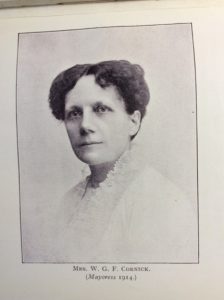
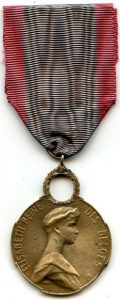
In reporting the ‘Medal to the Mayoress’, the Bridport News noted that ‘The cry of pain and anguish has never yet failed to find a warm response in the hearts of the Bridport people’ (BN, 2.8.1918). The public presentation of the medal occurred during the 1918 secondary school prize-giving held in the Town Hall. The current Mayoress, Mrs Jean Edwards, had worked closely with Tryphena Cornick in this work and spoke warmly of how “she brought her powers of organisation to bear in this relief work, as there had been no previous experience of the kind”. She said the award recognised that Mrs Cornick had done the spade work and drudgery behind the scenes when the town opened their hearts and homes to the Belgian refugees. Mrs Cornick had turned her house into a second hand shop for old clothing, added to which vegetable products were dumped down upon her. Jean Edwards said, to laughter from the audience, “housewives knew what it meant to have people wandering about the house to see old clothes and to have potatoes and other vegetables dumped down upon clean floors”. Mr Cornick, who was one of the town’s grocers, had provided his van for carrying furniture and food to the temporary homes of the Belgians. Mrs Cornick and her committee saw their work as a moral responsibility, as the town had invited these refugees to come to Bridport and it was felt that that ‘they should be able to live comfortably among us’. When the medal came, Mrs Cornick wanted to share it with the others who had worked so well – but Mrs Edwards ‘could honestly say that Mrs Cornick had worked far more than any of the rest of them, and thoroughly deserved the honour of this award’. Then Father Jules Ketele, a Belgian who was in charge of Bridport’s Catholic church, stepped up to give an eloquent speech, full of gratitude for all that had been done for his countrymen. He spoke in the name of the Belgian refugees still enjoying the hospitality of Bridport and those who had left. He congratulated Mrs Cornick on the receipt of the medal which recognised her excellent services: “Bridport would also be remembered for the noble and generous part she had taken in welcoming the refugees within the borough”. Mr Cornick replied on behalf of his wife (!) and himself, stressing that his wife felt that whatever had been achieved, she had only worked in co-operation with other ladies on the committee and “he knew she would feel more comfortable if every other lady who worked so nobly with her could share in her honour. It just happened that, by the kindness of their friends in Bridport, she was Mayoress at the time this work was started”. Other reports emphasised the zest with which she had undertaken this work – however we don’t hear her voice, only her husband speaking on her behalf. He concluded his remarks, ever the local politician, by asserting to applause: “Bridport has nobly responded to every call made upon her during the past four years of the war, and they have reason to be proud of the generous way in which these appeals had been met”.
As we have seen, there were a number of occasions during their stay in Bridport that Belgian refugees organised events in which they gave their thanks to Bridport people for their generosity and hospitality, particularly to those who had organised the practical help they had received. Other than on those occasions, their voices and the detail of their experiences generally went unheard. However there is surviving testimony of one refugee family who spent the war in Bridport.
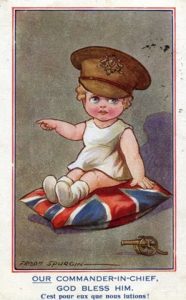
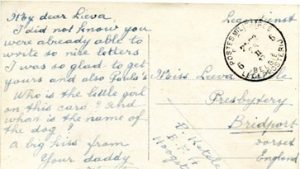
Helena Verbrugghe, aged 33 and living in Westkapelle, fled to England in September 1914 with her 3 children (Paula, 4, Godelieve, 2, and Jozef, 1), and pregnant with her next child. They turned to her husband’s brother and sister: Jules Ketele, a priest who had initially worked as a missionary in Plymouth, and his sister, Margriet, who served as his housekeeper. In 1914, Father Jules Ketele was appointed parish priest in Bridport, and it was therefore to Bridport that he welcomed Helena and her family along with his mother Maria Eugenia Ampe, his elder sister Maria, and Helena’s fourth child Patrick, who was born on St Patrick’s Day 1915. Before the war, Helena’s husband Paul had been head of a primary school in Westkapelle. When the country mobilized for war, he was first sent to Veurne as a stretcher-bearer and later to Hoogstade; when he was entitled to leave, he spent some of it with his family in Bridport. In 1917, he was seconded into the Queen’s school at Wulveringem, where he was a primary teacher until the end of the war, while his family remained in Bridport. Their father regularly sent the children postcards, even exchanging small messages in English with the eldest ones. His family returned to Belgium in April 1919.
Here is one of the postcards received at the Presbytery in Bridport:
Less directly, the experience of some Belgian refugees in Bridport can be glimpsed through court cases. From their arrival, the refugees had been subject to the Aliens Registration Act passed at the outbreak of war which stated that foreigners had to register with the police and needed permission to move to a different address. Although initially designed to deal with so called ‘enemy aliens’ and as part of a spy fever that swept the country, it was soon made clear that this registration applied to friendly aliens and specifically Belgian refugees, as this notice from the Western Gazette, makes clear.
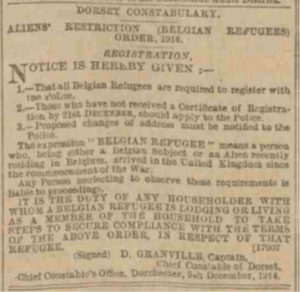
(WG, 11.12.14)
Cases of Belgian refugees caught up under the Aliens Registration Act began to be seen in Bridport. The detail of such cases made clear the way in which some refugees’ lives played out in exile. In May 1916, a Belgian refugee named Jacques Thibaut was summoned by the County Petty Sessions for failing to register himself as an alien and not giving notice when leaving one district for another. In April that year he had reported to Bridport police station where he was asked whether he had obtained permission from the Chief Constable of Dorset to come into this ‘prohibited area’. He said he hadn’t, and also that he did not have an identity book. He had come from Leeds(where he had not registered) to London, and then on to Westmead, West Allington, the 19-roomed home of Alice Fox Colfox (1856-1936). By the time of the court case Thibaut (who had just turned 18 which was when the regulations started to apply) had acquired registration papers from Leeds dated 22 September 1915. His first registration was at the end of 1914, aged 16, when he was living at Pier Terrace, West Bay. When he was next heard of, he was at Westmead, although he had given no change of address. He and his mother were seen, and cautioned that they must notify any change of address. Then it seemed he had left Westmead and gone away with his father to France. By July 1915, he had returned to Westmead, but 2 months later he left again, giving no notice of where he was going. He was not seen again in Bridport until April 1916 when he appeared at the police station. By then, Miss Colfox had opened up her large home to the Thibaut family. She explained to the court that she had no idea that Bridport was now a prohibited area, as it had not had that status when she had taken in the refugee family. She had informed the police 2 or 3 weeks before she expected the return of Jacques Thibaut – but it was too late for him to get the necessary papers from Leeds. The young man had been accepted into the Belgian army but was not due to join them for 6 weeks. When he came to see his mother in Bridport, she took him straight to the police station. He had travelled via London so that he could see his brother who was on short leave from the Belgian Army. The bench made it clear that, whatever the circumstances, Belgians must not move from one town or part of a town to another without getting a permit. Thibaut was fined 5 shillings and reminded that he could only move from one district to another with a permit. The story of Jacques Thibaut, together with the records from other prosecutions of refugees and ‘friendly aliens’ in Dorset, suggest that there was considerable mobility around the country, with some of the refugee men crossing back and forth across the Channel as they sought ways to support their families or to serve in the Army.
Sadly the First World War did not see the end to the many conflicts across the world which created refugees. Appeals to support displaced people and even to provide hospitality to them were to be heard in Bridport throughout the twentieth century. However, the generous spirit of Bridport’s response to the Belgian refugees was not always evident in later times.
One example was the local response to calls to aid Jewish refugees from interwar Europe, particularly Germany. In the months before the outbreak of the Second World War, some voices were raised in Dorset which were critical of funds being raised for Jewish refugees. On 14 January 1939, the entertainment industry across the country agreed to give 10% of its box office receipts to the Lord Baldwin Refugee Fund. This elicited a letter of protest from Robert Saunders of Broadmayne, near Dorchester. He claimed that ‘many would surely have preferred some other object to have been chosen to receive this benevolence. To me it seems bad enough to permit thousands of aliens to enter this country and take jobs from our own people. …. [It] can only add to the injury already done to our unemployed and to the insecurity of those who have jobs. Charity should begin at home, and even if it should not stop there, it would at least do well to remain until the distress of our own people (especially in the distressed areas) has been alleviated. But in England today “Britain Last” seems to be the guiding principle.’ (WG, 13.1.1939)
Saunders revealed his true colours when he went on to assert that the Jewish Board of Guardians were intending to offer season tickets, tools, instruction and even premiums to those who took on Jewish boy refugees: ‘What chance has the English boy against such odds?’, he asked. What Saunders did not admit was that he was the Dorset organiser for the British Union of Fascists, which had held a number of meetings in Bridport. However, his views were not allowed to go unchallenged. Dorothea Austin Taylor of The Lodge, Chideock, made the case that refugees might actually be ‘a very decided asset’. She suggested that the agricultural knowledge that Jews had already shown in Palestine, together with the house pride of German women, might make these refugees particularly useful in Dorset. Moreover, they would not, she thought, be staying long as ‘they are only supposed to be here pending their removal on a large scale to lands to be found for them’. In the meantime, she suggested that those who wanted to give Jewish refugees employment should contact the (Quaker) Friends House in London (WG, 20.1.1939). On Mother’s Day 1939, collecting boxes appeared across Dorset, including in Bridport, to raise money through the Lord Baldwin Refugee Fund to get a further thousand children out from Germany, Austria and Czechoslovakia. The Dorset Refugee Committee said that it was taking responsibility for 30 children, explaining that these children could now not go to school, museums, shops or public parks, just because they were Jews (WG, 1.5.1939). It was Baldwin’s Fund that contributed to the financing of the Kindertransport which helped about 10,000 children escape Nazi occupied Europe.
We know of one Bridport family who did provide a refuge for a family fleeing Nazi persecution in Germany. The Quakers Edward and Mabel Reynolds provided hospitality to a German Jewish doctor (Paul Mayer), who was fleeing Germany with his wife and daughter, at their house Tynrhos on West Bay Road. Once the war began, Paul and Irma Mayer continued to live with the Reynolds, but were registered as enemy aliens. However, they were exempted from internment, which was the fate of many other refugees. In April 1940, the Mayers managed to sail with their daughter Ursula (who was training to be a children’s nurse in London while her parents lived in Bridport) for New York, where they hoped to become American citizens. It would be interesting to know whether other Bridport families gave sanctuary to Jewish refugees, and what happened to their guests.
The stories of welcoming refugees to Bridport continued after the war. One example comes from the early 1980s when the old North Allington Hospital was turned into a reception centre for Vietnamese ‘boat people’ by the Ockenden Venture. The premises were licensed to house refugees until homes were found for them. Again, do you remember this? Were any of these refugees re-housed within the Bridport area?
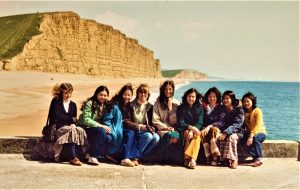
Vietnamese refugees at West Bay With thanks to Carol Hyde
Bridport has welcomed refugees over the years and has been generous in fundraising for refugees overseas. Local people have shown considerable ingenuity and tenacity in making practical arrangements to support destitute refugees: will we do it again?
Professor Karen Hunt, March 2021
How can you help?
Share your memories. Have you or your family welcomed refugees into your home? Do you have any objects that connect with these stories? Does anyone know what happened to Tryphena Cornick’s medal? And, of course, you can support Bridport Refugee Support Campaign
Want to know more?
For examples from other parts of Britain, see the essays in:
[1] The calculation of the value of currency in the past is not an exact science. To give an indication of approximate value in the past, I have used the Bank of England’s converter which calculates what goods and services purchased in a particular year in the past would cost today (2020)
All of the information included in this article is correct to the best of our knowledge. However, if you believe anything is incorrect, or would like to submit further information, then don’t hesitate to get in touch.