

Shipbuilding
Research volunteer Joanna Garner has been exploring 100 years of the shipbuilding industry in Bridport Harbour.
Research volunteer Joanna Garner has been exploring 100 years of the shipbuilding industry in Bridport Harbour.
For many years hemp and flax crops were grown in the Bridport area and were used in the rope and net-making industry. King John had ordered the Sheriff of Dorset “to cause to be made in Bridport night and day as many ropes for ships both large and small and as many cables as you can.” Bridport had the monopoly on this production, and King Henry VIII confirmed it when he ordered all ropes and cordage for the navy to be made at Bridport.
The 1825 painting of Bridport Harbour by William Daniell (above) is in our collection, and clearly shows the shipyard on the right-hand side. The shipyard at Bridport Harbour operated between 1769 and 1879 and was the most productive shipyard of the time in England. In its 110 year history, the yard built 353 vessels, including 18 ships built for Lord Nelson’s navy during the Napoleonic Wars in the early years of the 19th century . Many different types and sizes of vessels were built there, including cutters, brigantines, barques, brigs, clippers, frigates, ketches, luggers, schooners and smacks; much of the wood used in constructing these vessels came from local woodlands. Out of the yard came cutters for the Board of Customs; these vessels needed to be swift in the water for Customs work, and the skilled Bridport shipbuilders achieved this by developing their own construction methods. It also produced the fishing smacks that sailed from Leith to London. The largest frigate built at the yard was named the ‘Laurel’ and carried 22 guns. At one point 300 people were employed at the shipyard to build and maintain the ships and boats. It would have been a frenetic, dangerous and very noisy place to work, with the sound of hammering and wood sawing and the smell of paints and tar filling the air.
The first ship to be built and launched at Bridport Harbour from one of its six slipways was the ‘North Star’. It was built in 1769 by Nicholas Bools who also established the shipyard. Towards the end of the 18th century, Bools lived in Jessops House, East Street in Bridport, where he built a watch tower from where he could use a telescope to keep an eye on his shipyard as well as watch what was happening out at sea. Bools went into partnership with his son-in-law William Good, a fine shipbuilder who eventually became the senior partner in the business. In 1830, John Cox took over the shipyard. He was a Wesleyan preacher and a local man who played a major role in the building of the Methodist Chapel on the beach, now the West Bay Discovery Centre.
The largest vessel built at the Bridport yard was the clipper, ‘Speedy’. It was built in 1853 by John Cox for Prowse and Company of Liverpool, and weighed 1002 tons. ‘Speedy’ was made of oak and teak, and was slightly larger than the more famous ‘Cutty Sark’, now at Greenwich. The clipper carried passengers to and from Australia; its first voyage took just 92 days.
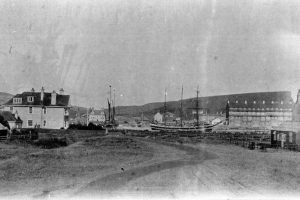
A view of the shipyard in the 1920s.
The last ship built at Bridport Harbour was the ‘Lillian’, built for Job Legg, the owner of the local Brewery, and launched in 1879. Wooden ships were now being replaced by iron ships, which were being built elsewhere – and the shipyard at Bridport Harbour eventually closed in 1885.
Joanna Garner- Research Volunteer
(adapted from an article original published in The Bridport Times)
All of the information included in this article is correct to the best of our knowledge. However, if you believe anything is incorrect, or would like to submit further information, then don’t hesitate to get in touch.