Sylvester Wilkins: was this Justice … or unjust punishment ?
Volunteer John Darwood tells the tale of the young boy who was hanged for arson…
Volunteer John Darwood tells the tale of the young boy who was hanged for arson…
Around 10pm on a cold, windy February evening in 1833, Bridport’s Fire Bell was being furiously rung, demanding all able-bodied men to come and deal with a serious fire. Although there had been several recent small blazes which were thought to be arson, this fire call was serious, and the blaze could be seen from the town centre. Despite the good efforts of townsfolk, the fire was fanned by the strong wind, quickly spread, and a whole terrace of eight thatched homes in King Street (now Long’s Fish Bar) was quickly reduced to a pile of burning rubble. One can only imagine the townsfolk’s anger as the devastating consequences of this fire left thirty people homeless.
Local suspicions were soon confirmed when three Bridport youths were arrested and sent for trial at the next Assizes in Dorchester. David Curme and John Middleton, both aged seventeen, blamed their younger companion, Sylvester Wilkins, who admitted starting the fire for a lark.
The trial took place on 13 March, presided over by Sir Joseph Littledale (a senior London Judge) who heard that Middleton, one of the older youths, had been promised a lesser sentence himself for a previous arson if he turned King’s Evidence (assisted the Prosecution) against the younger Sylvester. It has been speculated that the older youths knew that, if they were convicted, death would be the likely outcome, whereas if the younger one pleaded guilty, he would receive a lesser sentence.
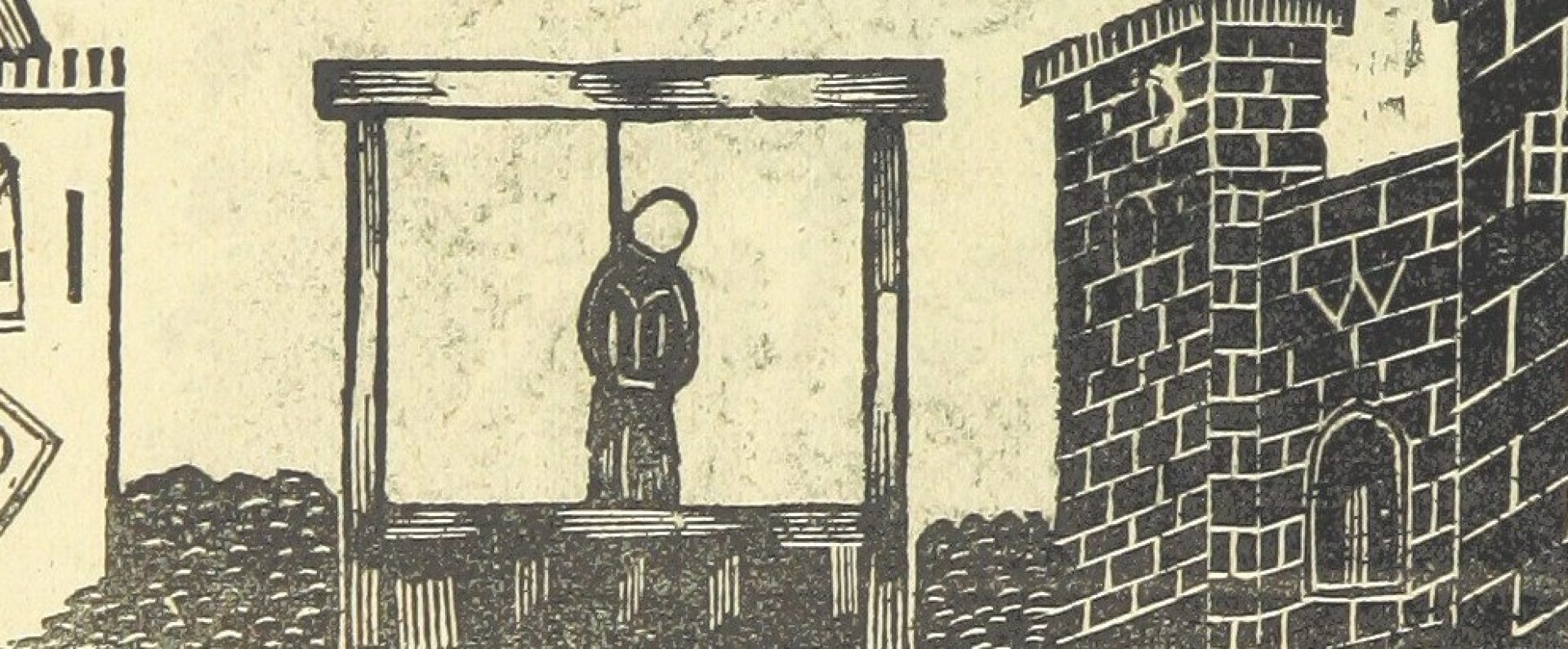
The jury duly found Sylvester guilty, but as he was only 15 and of previous good character, they recommended mercy. However, the learned Judge would have none of this and immediately handed out the foulest punishment: death by public hanging. Until 1868, executions were great public spectacles, and there were still over 100 different crimes for which the punishment was death.
In those days, the High Sheriff (Richard Brouncker of Boveridge) had responsibility for arranging executions, and executioner William Calcutt (infamous for his short-drop hangings) was employed to hang Sylvester. This took place at noon on Saturday 30 March outside Dorchester Prison. As he was of slight build, the prison Governor had ‘mercy weights’ made of lead strapped to his legs to increase his weight and hasten his death; one of these can be seen in Dorset County Museum today. Sylvester’s funeral was held on Good Friday 5th April in St Mary’s Church, Bridport where he had been a choirboy, and was described by a contemporary diarist as a large event with over 2,000 people filing past the coffin and lining the streets, perhaps a reflection of the horror local people felt at this tragic outcome. He was buried in an unmarked grave in the churchyard. Unsurprisingly, neither of his two accomplices, Curme and Middleton, is listed in the following Census Returns of 1841 or 1851 for Bridport.
In July 2013, children from Symondsbury Primary School created a play based around the sad story of Sylvester Wilkins and performed it in Bridport Town Hall which appropriately, had been the Town’s Courthouse for many years.
John Darwood- Volunteer
Find out more
Report of Wilkins’ Trial published in the Morning Post
Animation of Wilkins’ story made by local children with animator James Price.
All of the information included in this article is correct to the best of our knowledge. However, if you believe anything is incorrect, or would like to submit further information, then don’t hesitate to get in touch.